

Unfracking Your Attention
Protecting our human resource.
SPRING SHOP SALE: 20% off all orders between now and April 5th // Want writing inspiration this spring? Sign up for the DIVE Seasonal Writing Group spring session — this beloved seasonal offering led by Kerri Anne kicks off in early April.
Hello friends,
Black bugs have been everywhere, crawling all around the house. In the kitchen. On the window. On the back of the couch. Crawling across a book, a lamp, my arm.
At first glance, without really paying attention, I thought they were stink bugs, emerging from their winter hibernation. But upon closer inspection, these ones were longer, more slender. Up close, bright reddish orange lines crisscrossed along their back.
Annoyance was the initial reaction. Isn’t it usually when you have insects crawling all over the house?
I did a little bit of searching online. Boxelder bugs. Felt better to at least know what to call them. Ah, I see: related to stink bugs and cicadas! No wonder the internet defined them as a “nuisance.” Although the more I read, I couldn’t entirely determine why. They don’t injure you or your pets, they don’t bite or carry disease. Worst case scenario if you squash one on the couch, they might stain the fabric. In other words: a housemate that hangs around a little unexpectedly but that’s essentially harmless.
They’ve even been called “accessible ambassadors for nature.” As Chris Helzer of The Nature Conservancy writes, “Boxelder bugs make themselves easily available to us, but we have largely failed to take them up on their obvious offer of friendship.”
Knowing their name at least felt like a step in the right direction. The more I looked at them, the more stunning I found the black and red pattern. A striking contrast, a little bit of flair and flourish.
Sitting on the couch one morning with my computer on my lap, I noticed one on the sleeve of my sweater. I placed my pointer finger directly in front of the bug, encouraging it to walk onto my hand.
The boxelder bug crawled along the backside of my hand, until I slowly rotated my wrist and the bug followed my movement, inching its way over to my palm. There on the couch with the digital world at my fingertips, it was as if the bug was saying, “hey you, take a little time to pay attention.”

I mentioned a couple of weeks ago in the newsletter that I had decided to put my phone on grayscale mode, an attempt at making the device a little less desirable. First popularized by technology ethicist Tristan Harris (you may recognize his name from the docudrama The Social Dilemma, or his phrase “If you’re not paying for the product, you are the product.”). Originally inspired by an experiment at Google where M&Ms were placed in opaque containers instead of clear ones, in turn reducing snacking habits, the idea with grayscale is kind of the same thing. By changing the color, you cut out the tempting visual candy.
It worked far better than I had anticipated. A screen in pure black and white with a lot of contrast might have been one thing, but the assorted variations of gray? It just looks like one brain numbing jumble. I pick it up to send a text, and do so as quickly as possible so I can put it away again.
When I’ve shown my screen to friends they vigorously nod in agreement, “oh yes, that looks terrible.”
The awfulness has a payoff: my screen time is down by two hours a day right now, and without really feeling like I had to make any effort to do so. “What are you doing with the extra time?” my husband asked me.
“I don’t know, staring at trees?”
There is plenty of screen time in my life. The emails on my computer, reading on my iPad, texting on my phone. But at the very least it feels like I have gotten small windows of time back. Certainly the ones in between activities. On a rainy day waiting in the car at the post office, I watched the patterns emerge in a rain puddle.
This grayscale business is nothing new. Harris told a reporter about it a decade ago. And the idea that screens and devices are a sinkhole for attention? Also nothing new. But lately, I’ve found myself on a more intentional search for a way back to my own attention. I am sure that many of you have some version of this.
The desire stems from a combination of things, but I think a big one is the intensity of the current moment. There are so many horrors for my brain to comprehend and process. I don’t just want to have an emotional reaction, I also want to be able to formulate a thought. This gets more complicated the more that I take it. Things get muddled. It doesn’t feel good.
I picked Timothy Snyder’s On Tyranny back up again the other day, and chapter 9 stood out: “Be kind to our language.”
“The effort to define the shape and significance of events requires words and concepts that elude us when we are entranced by visual stimuli. Watching televised news is sometimes little more than looking at someone who is looking at a picture. We take this collective trance to be normal. We have slowly fallen into it.”
A collective trance. Sound familiar?
He reminds us that:
“More than half a century ago, the classic novels of totalitarianism warned of the domination of screens, the suppression of books, the narrowing of vocabularies, and the associated difficulties of thought.”
Our attention is a finite resource. We must wield it wisely. If we don’t, there is a significant cost.
I have found myself in multiple conversations lately where it appears that everyone is struggling to make a point. These conversations aren’t short on words—there are lots of assorted thoughts and opinions shared—but it seems impossible for anyone to ever land the proverbial plane. A kind of conversational slop.
I’m not immune. There have been times when I’ve had an almost out of body experience, watching myself from the outside as I get sucked into a spinning vortex when I’m not really sure what I’m arguing or what I’m referencing anymore. Just words, phrases, and unintelligible half sentences.
It’s a chilling feeling. Makes me want to immediately find my way to a notebook to be able to map out a solid thought, write my way through what I am actually thinking to ensure I am not just regurgitating snippets of what I have consumed.

“Human attention is the stuff out of which we care for ourselves, our communities, and our planet,” write the authors of the new book Attensity: A. Manifesto of the Attention Liberation Movement, which I picked up and read this week. “When it is fractured and polluted, all forms of life suffer.” Like oil companies digging deep into the earth to extract energy intensive resources for great profit, our attention is also being fracked.
Reading the book, I couldn’t help but feel that the authors were intentionally playing with my own screen-influenced attention habits. There were plenty of words in all caps, a lot of italicization, some lines in bold. The product of people who know how our brains have been molded by the attention-grabbing forces.
In the digital age, it’s the ONLY way we stop and pay attention.
My eyes actually have a difficult time with that on the printed page, but I understand the drive, particularly in a book that is written as a manifesto.
The authors argue that our current understanding of attention is narrow, largely informed by scientific research which turns attention into a specific, quantifiable, measurable thing that we do. In this line of thinking, attention is our ability to focus, our ability to stay “on task.” Of course, attention is more than staying focused on screen-based endeavors.
“…giving your mind and time and senses to the world and using your mind and time and senses to receive the world and other human beings, properly understood, that’s human attention,” co-author of the book D. Graham Burnett said in an interview. “It also involves daydreaming and taking care of a child and burying your dead—those are attentional activities.”
Attention is care, attention is curiosity, attention is connecting. Attention is human.
There is a growing amount of literature on attention. Jenny Odell’s How to Do Nothing is one I know a lot of you have read. Just yesterday at a bookstore I spotted another one with a bold cover shouting at me—funnily enough titled, The Sirens’ Call. Are we at a tipping point? Could we go so far as to be hopeful about our own attention?
The authors of Attensity! (the “Friends of Attention” as they’re known) project that by 2040 “attentional wellness” will be understood as a basic good. In their words, this “attentional wellness” is defined as “the training and conditioning and maintenance of one’s diverse attentional capacities.” Just like we exercise in order to maintain our physical health, our attention requires the same.
But this requires our own investment in “the kinds of attention that are not engineered not maximize digital advertising revenue.” In other words, the moments spent looking at the boxelder bugs crawling along your wall, or the time spent in a conversation with a friend, or staring out the window because the sunlight is hitting at a beautiful angle.
Artists of course are well-poised for the task.
“They are a little like the cavalry in the joyful, peaceful army of Attention Activism. They can move fast, scout the terrain, and close quickly and wickedly on the enemy. They draw on a rich and deep set of traditions—critical play, heightened sensitivity, fierce and irreverent independence, a preoccupation with craft, the libidinal fellowship of making and sharing—that align powerfully with the work of fighting the human frackers. Moreover, there is a long-standing streak of maverick idiosyncrasy in the world of the arts. A longstanding willingness to pin value on things other than money—plus a happy vigor in showing the middle finger to much of what passes as convention.”
When I read that paragraph, the work of Mierle Laderman Ukeles came to mind. In 1977, she became the first Artist-in-Residence at the New York City Department of Sanitation, an intersection of artist and public agency that “transformed our notions of public art,” as Queens Museum Curator Larissa Harris and Art Historian Patricia C. Phillips put it.
Sitting down at a typewriter in 1969, Ukeles wrote her famed MANIFESTO FOR MAINTENANCE ART, 1969! outlining her own experience as an artist and mother and that of the city’s sanitation workers. As she wrote in the manifesto:
“The sourball of every revolution: after the revolution, who’s going to pick up the garbage on Monday morning?”
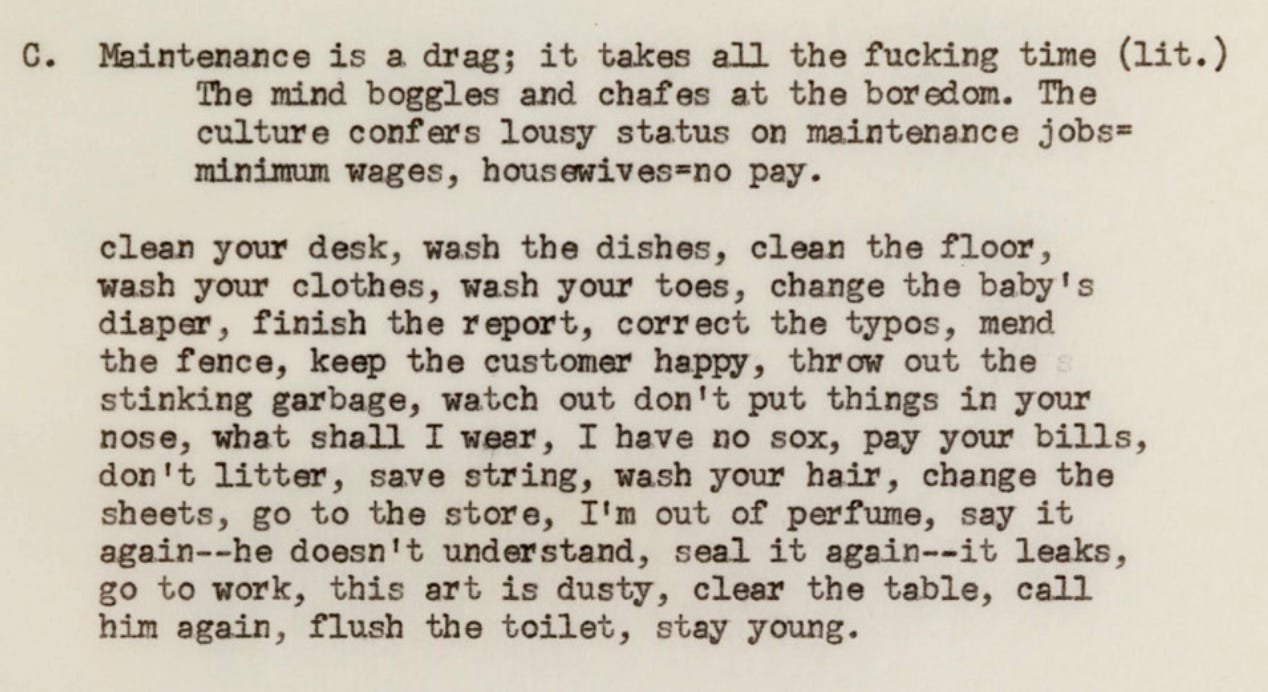
C. Maintenance is a drag; it takes all the fucking time (lit.). The mind boggles and chafes at the boredom. The culture confers lousy status on maintenance jobs = minimum wages, housewives=no pay.
Ukeles deeply understood that there is so much labor required to make our world go round, and so much of it goes unnoticed. But as an artist, she could take on these maintenance tasks “and flush them up to consciousness, exhibit them, as Art.”
Her first piece as the official Artist-in-Residence was called Touch Sanitation Performance. From the summer of 1979 to the summer of 1980, Ukeles shadowed sanitation workers, joining them at their 6am start time, keeping up with them through the workday and eating together on the curb when restaurants refused to serve them. As a part of this process, Ukeles committed to what she called a “Handshake and Thanking Ritual.” Over the course of the year, Ukeles shook the hand of every single sanitation department employee—all 8,500. As she shook their hand she said, “thank you for keeping New York City alive.”
One handshake and a thank you may not sound like much, but as then Department Commissioner Norman Stiesel noted, the simple act “opened up a hurt that each one was still carrying from when he felt humiliated.”
In an interview Ukeles recounted the story that one sanitation worker shared with her after she shook his hand and thanked him:
“17 years ago it was very hot, very humid… We stopped for break, and sat down on some lady’s porch steps after we had dumped her garbage. She opened up the door and said, “get away from here, you smelly garbagemen. I don’t want you smelling up my porch.”
That stuck in my throat for these 17 years. Today you wipe that out.”
As Ukeles said, “that was the best thing that ever happened to me as an artist.”
A work of art—whether it’s a dance, a song, or a book—is a request for our attention. Something that says, “hey you, stop here and stay awhile.” As artists and writers, we have the power to wield that attention, use our medium to point out what we see as important, what we want to ensure does not go unnoticed. We point and say, “this thing over here? yes this thing deserves your time.”
That continued act of attention is a way to unmuddle the pieces. Figure out what is important, do your research, connect the dots, make the argument.
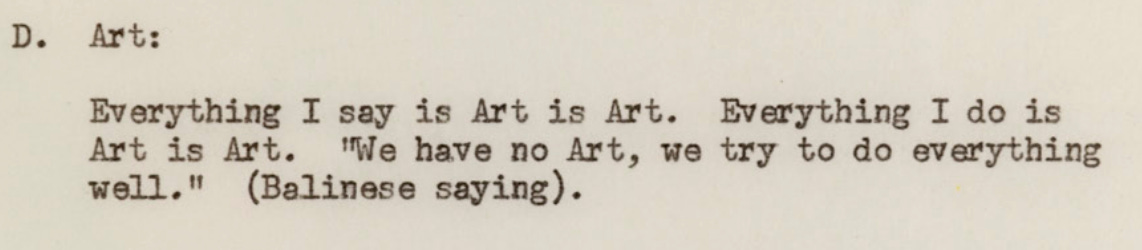
One of my favorite part of Ukeles’ manifesto is her line “Everything I say is Art is Art.” We all get to decide where our attention goes, and I like this lens. Art is paying attention to the unseen. Art is choosing where our attention goes. Art is being receptive to all of the unexpected ideas and illuminations that happen during the in between moments, when we remember to honor them with our attention.
In this world where everything has the power to be art, the boxelder bug crawling along the window isn’t a nuisance, it’s a performance piece. Maybe that’s a stretch, but why not aim to see the world in this way?
Life is not an accumulation of minutes and moments that can be quantified, and either is our attention. We deserve to be more vigilant about it. Attention, after all, is what makes the world more alive, more vibrant. Attention is what feels our days full of meaning. Attention allows us to connect and understand.
You can’t track that, quantify that, turn it into a metric. But you can feel it. Know that it’s worth protecting.
-Anna
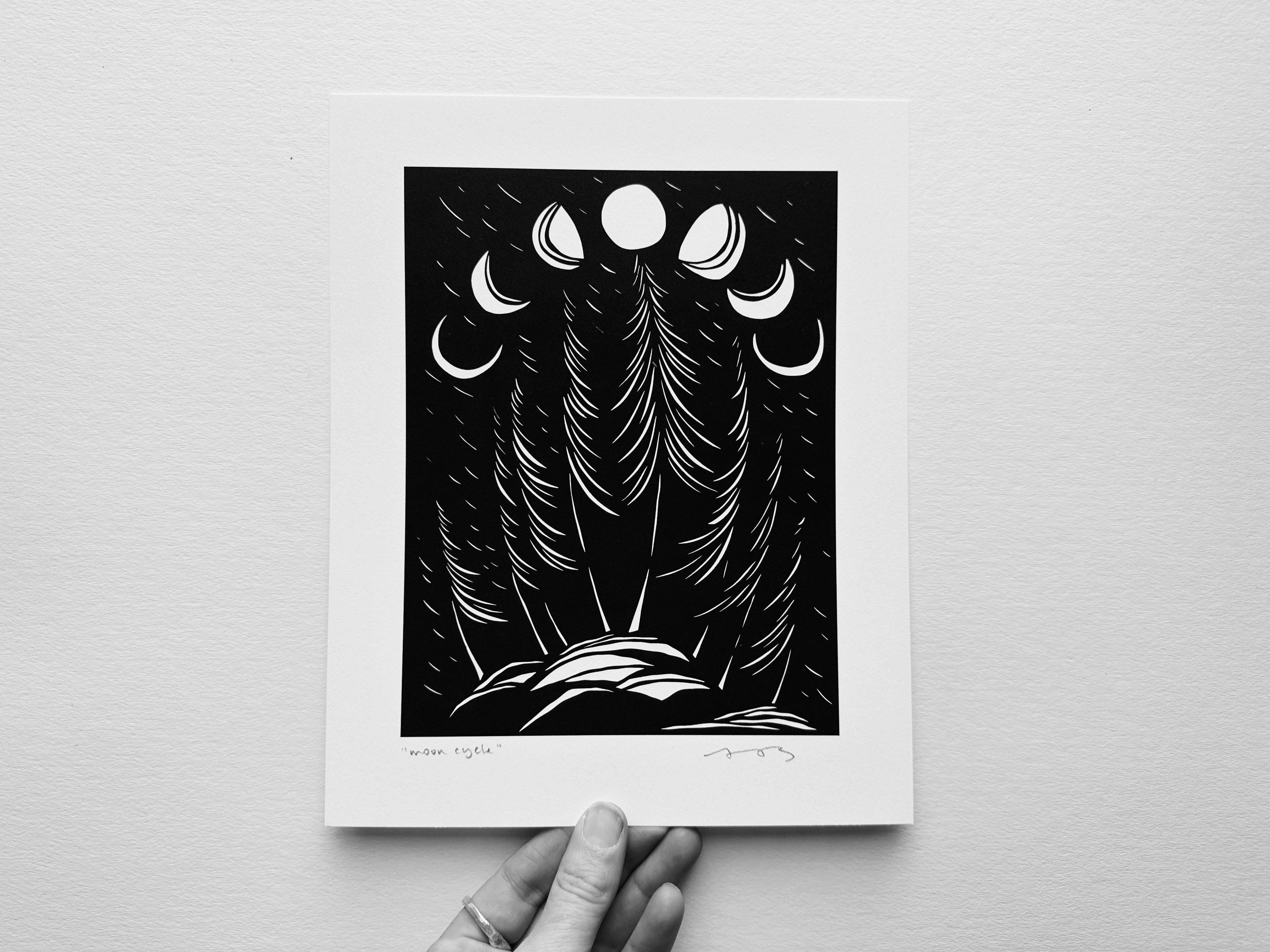
SHOP SALE
It’s time to do a little spring cleaning in the studio! 20% off all orders in the shop between now and April 4h. Buy all the art! Gift it to your friends!

DIVE Writing Group: SPRING 2026 Session
The next session of DIVE, the Creative Fuel Collective seasonal writing group starts in April! Join Kerri Anne and make spring a season of writing. Three months of weekly prompts and check-ins, and monthly meetings with fellow creatives. Choose between the Tuesday and Thursday session.
—> Spring 2026 TUESDAY Cohort - Meets April 7, May 5, and June 2, 4-6pm PT
—> Spring 2026 THURSDAY Cohort - Meets April 9, May 7, and June 4, 4-6pm PT

Fantastic. Thank you. Yes. Off to caress pine needles with my toes. And yes again, Dive was wonderful: The sound of Pencil on paper. Ideas I didn’t know I had. Lovely.
Putting my phone on grayscale now!