

Circular Creative Economy
On art, money, and the holiday season.

NEW FUN THINGS in the shop: permission slips, garlands and ornaments, winter solstice cards, and more!
REMINDER: The 9th edition of 24 Days of Making, Doing, and Being digital Advent calendar starts on December 1st — all you need to take part is a paid subscription.
Hello friends,
Last weekend, I walked into a building filled with booths of artists and makers. Just a few steps through the door and I could sense the well-known feeling starting to circulate in my body: overwhelm.
Like many artists and people who make things, I spend this time of year trying to navigate the intensity that is served up by the economic holiday season. The entire autumn has gone to finishing projects, and now all I do is keep ensuring there are enough shipping supplies, packing boxes, tripping over said boxes, printing shipping labels, looking at spreadsheets, folding pieces of paper that serve as packaging, putting price labels on things, etc.
All of this was in the back of my mind as I walked into the market. The personal overwhelm caused by a studio packed with boxes and products, but the larger overwhelm of a culture that’s insistent on mass consumption. “Buy more things! Buy them now!” my email inbox has been shouting at me all month long.
When I walk into a bookstore, my brain often does a bit of a short circuit as I think about the hours of work in every single book. It is unfathomable. Same at a market. I think of the hours spent making the art, but also the hours put into marketing, the labor of selling, even just the time spent packing the car and setting up the booth that day.
If I had a magic wand, I’d gift every single one of those artists a stipend. Money that ensured they could keep doing what they do, make whatever they wanted, not have to consider how it would need to be sold.
I don’t need or want to buy everything in a holiday market. But I do want the artists to continue to do what they do.
Because I want to live in a world where humans make things.

If you make things for a living, you inevitably end up expressing a lot of gratitude.
“Thank you for buying my book!”
“Thank you for coming to my show!”
“Thank you for supporting my work!”
We reformulate some version of this so many times it can easily feel like the statement loses its value. But even if I can’t find new creative ways to say the same thing, I always connect with the sentiment. I do in fact feel very grateful when someone chooses to support my work.
I try to imagine people in other professions doing the same thing.
What if you went to the doctor and after your appointment was over they said to you, “thank you so much for supporting my work.” Or what if a lawyer said it to you after an hour in their office? A dentist after a cleaning?
Flipping the script in this way helps to get at how much we undervalue creativity as a society. Sure, we want films, music, and books, but actually supporting that work is a different story.
We devalue creativity because we can’t fit it into the normal models of how we understand goods and services. Art usually only gains value when we can fit it into more traditional economic models—the reason there can be such a difference between payment for fine art and commercial work, and why the second someone views art as an investment then it’s finally worth supporting.
Even if we truly, genuinely mean it when we say “thank you for supporting my work,” the grateful language we use still carries the undertone of “you didn’t really need to buy this, so thank you for doing so.”
I wonder if our over-expression of gratitude does us a disservice, implies to our audiences that this is something we do “just for fun”? This is an underlying assumption after all—you must only be on a creative career path because you choose to. You could at any time go and bail for something that is more “reasonable.” And if you’ve made the choice to stick it out on this weird path, then certainly it’s ok to be underpaid, right?
I also can’t help but think that the expression of gratitude is exactly what makes creative work so beautiful. Art is reciprocal in ways that other industries are not.
We’re used to a transactional economy, defined by a one-to-one relationship: buy something, get something. Art and creativity don’t work this way.
In creative work, hours in do not equate to dollars out. Think of the writer who has to spend a decade researching and writing their book. Or the painter who spends years working on the textures and color palettes that finally become their signature? It’s a different process, even when there’s money attached.
Here’s Julie Cloutier writing about the art of craft:
Making a mug that takes 6 weeks is not about making a profit. Ha! There is a monetary exchange, but the slow process of creating something from nothing with your hands from start to finish rejects notions of mass production and mindless consumerism.
We’re trying to do things differently. Our work may be packaged in a way to be sold, yet compared to the traditional goods in a consumer economy, creative work is often imbued with the ethos of an offering.
We want to share stories, beauty. We want our work to spark curiosity, cultivate connection.
The payment is a way to ensure we can keep making more offerings.
“Thank you for the work you put into the world” I wrote the other day in a comment on a friend’s newsletter. It’s yet another phrase that I definitely overuse but stand by. There are so many people creating beautiful things who don’t get paid for what they do (or get paid measly amounts).
Gratitude won’t pay the bills, but in a culture that has put a premium on complaining and publicly commenting only when something goes wrong, it’s even more important to celebrate and express when you connect with someone’s creative work.
I appreciate having a sense of human emotion run through what I do. It’s why artists are artists. You can’t be a good artist if you silence your emotional side. You can’t engage and respond in the world in the same way. If you want to turn your humanness off, choose a different career path.
In this way, art has the potential to be more than just transactional. Art is not just a service in exchange for money. Art encourages a relationship.
Even if you never engage directly with the artist, the art itself becomes a channel for connection.
Last year a friend gifted me The Serviceberry: Abundance and Reciprocity in the Natural World by Robin Wall Kimmerer, and because I was thinking about the idea of gratitude and reciprocity, I finally went to the bookshelf to read it.
In it, Kimmerer takes lessons from the natural world and explores what a gift economy looks like:
“I cherish the notion of the gift economy that we might back away from the grinding system, which reduces everything to a commodity and leaves most of us bereft of what we really want: a sense of belonging and relationship and purpose and beauty, which can never be commoditized.”
Kimmerer writes eloquently about land as a “source of belonging,” as opposed to our capitalistic view that land is a source of “belongings.”
It got me thinking about this in the context of art and what we consume.
Art that goes for millions at auction—often sold many times since the original sale where the artist made the money—is art as a belonging. Something to own, an investment.
But I’m interested in art as a way of belonging.
So many of us find belonging through art. The music that makes people dance next to strangers, the stories that pull a group of friends together around a dinner table at the monthly book club, the public art that sits in a park and serves as a background as people rest, play, and picnic.
I don’t want art to be transactional. I don’t want art to have to come with a price tag that turns away the individual who needs it the most.
I want an art-filled world, where murals make walls come alive, where impromptu concerts happen in public spaces and don’t require tickets, where people scribble ideas in notebooks and are encouraged to bring them to life, not because they’ll make great profit but potentially they might make great change. I want a world where creativity thrives in all corners.
I want art to be able to be an offering.
I also want artists to be paid. I want a culture that acknowledges that creative labor is labor, and labor deserves to be compensated.
I’ve been reading an advance copy of Mason Currey’s book Making Art and Making a Living: Adventures in Funding a Creative Life which is out next spring (Support an artist! Preorder the book!).
In these pages, it’s so clear that this conundrum between art and money is nothing new. We’ve been doing it for centuries.
I remember watching the Ken Burns’ documentary about Leonardo da Vinci1 last year. His final patron, Francis I—at the time the very young new King of France—gave him money, a small château, and a housecleaner. It all came with no expectation of output or result. “Must be nice!” I yelled at the screen.
Whether it’s patronage or trust funds, entrepreneurship or day jobs, creative people figure out a way to finance the projects that they want to do. But art as a job? It does feel more and more difficult these days, even when there are more tools available.
Even for those able to make a career out of it, there are all kinds of sacrifice involved, numerous nights of waking up at 3am wondering what happens if you injure your body, if you get sick, if you need to simply take a break.
“Should writers and artists get PTO?” Wendy MacNaughton asked this week, to which I say an enthusiastic YES.
I wish we had UAI, as my husband deemed it the other day: Universal Artist Income.
How do we support the act of making, the act of being, and not just the end product?
I hold The Serviceberry in my hand feeling what I often feel after I’ve finished a book: I want to keep it so that I can return to the words, but I also want to pass it on. The inscription my friend has written in green pen actually says: “gift after reading.” A specific ask. I’m not supposed to keep this on my bookshelf.
After all, isn’t this how I want my own work to be passed along? I can think of nothing better than writing a book that gets checked out week after week from a local library. Or making a public art piece that gets enjoyed by new people day after day.
In our transactional economy with our transactional way of being, it’s so easy to get hung up on our individual responsibility. How will I make money, how will I sell this thing. Or as a consumer: what do I get? I try to shift the equation: how do I support?
When someone buys something from me, where does that money go? After the rent and the healthcare and all the other things that need to be covered, it often goes to other people who are in the same boat: writes, artists, anyone eking out a livelihood from creativity.
I like to think of this as the Circular Creative Economy. One artist pays another, who pays another, who pays another, and we all just circle our money around again and again.
This goes beyond product and money. Support and investment in the Circular Creative Economy also means sharing generously what other people make, asking if people need help, and celebrating each other’s wins.
It means asking the question: how do we support the act of making, the act of being, and not just the end product?
I get into a kind of moral whiplash this time of year. I know so many artists who do.
Don’t buy anything, we don’t need more stuff / Support creatives, buy all the art and books!
I don’t want to see another gift guide! / Here’s a guide to some artists I like!
I don’t want another email selling me something! / Here’s another marketing newsletter with things I made!
Get off your screen! / Read my writing which is on a screen!
Quit your corporate job! / Stay in your corporate job so you have money to buy the art!2
There’s no right answer to this, there never is. It’s complicated, and we’ll all just keep wading through it the best we can.
But I do know one thing: I want more of the Circular Creative Economy. Not just because it supports artists. Because it also ends up supporting people who grow food, independent bookstores, art supply shops, environmental nonprofits, and all kinds of other people and organizations that weave together the fabric of our society.
It reminds us that our lives are not transactional.
We are in community with each other, and we need all the creative gifts that everyone is willing to offer.
-Anna
“Art isn’t meant to be something solely consumed in the background; it’s meant to start conversations and bring people together.” Tove Danovich on music and Rosalia’s new album.
“The culture tends to fetishise the product, But I’m just trying to twist the perspective. The relationship is the most important thing, because out of that everything comes.” Tilda Swinton
“Grant me the serenity to accept that I do some creative work for money, the courage to make art I don’t sell, and the wisdom to know the difference.” Ann Friedman’s Working Artist Prayer
“It is so vast out there, so finely textured; it is a wonder we see anything at all. But we cannot stop looking, always poised for the break in the pattern, the anomaly.” Katherine May’s “To the Lighthouse”
And finally… these snowy larch photos by Skylar Renslow
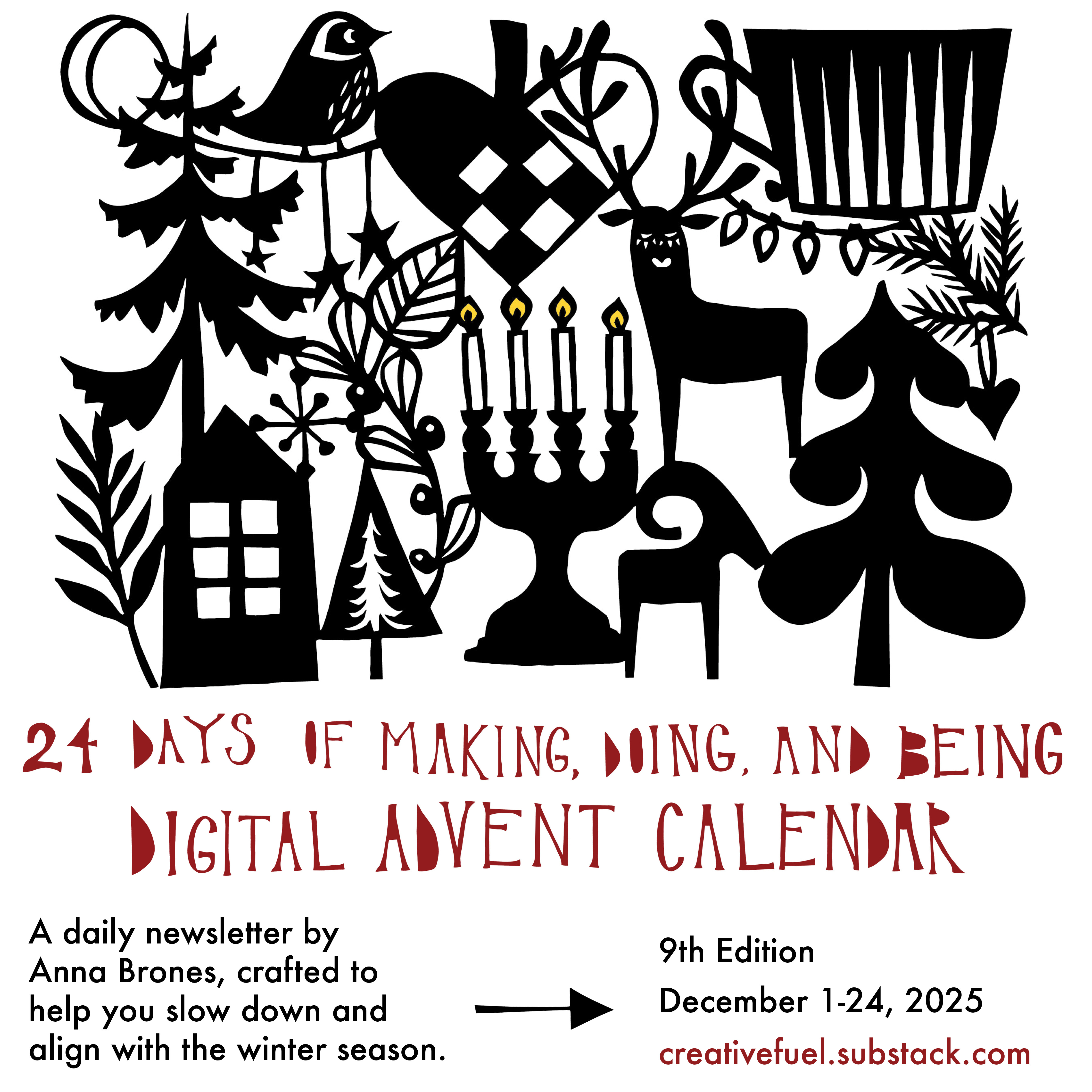
Sign up now for 24 Days of Making, Doing, and Being. All you need is a paid subscription.

What We Bring to the Table: A Writing Workshop About Food, Memory, and Meaning
In times of grief, growth, and especially transition, food often becomes the anchor: the way we remember, the way we connect, the way we process what lives beyond our own language. It’s how we pass down stories without words—through spice jars, seed packets, heirloom tomatoes, and the fragrant rituals that fill a dining room. Food connects generations, connects us to the land around us, preserves traditions. Food helps us celebrate and honor the people, places, and flavor profiles that shape our individual and familial stories. Join Kerri Anne for a one-time (for now) notebook-nourishing food-writing workshop designed to help you reflect on the year that’s been—and everything it’s stirred up or shaken loose.
Meets December 8, 15, and 22. More tickets + info.

Creative Fuel is a reader supported publication. If you enjoy reading, please consider becoming a paid subscriber.
Other ways to support my work: order something in my shop or buy one of my books.
Fun fact about Da Vinci: his last creative work was not a painting. It was a fabulous party, complete with a blue cloth painted in starts, music, people dressed up as celestial beings, and four hundred torches burning brightly. Exactly the kind of thing a creative person would want to indulge in making if they didn’t have to worry about making money.
thanks to Roshni for this one!
It is so cathartic to read about the artist-sales-holiday conundrum. I really enjoyed reading Julie Cloutier’s yesterday and now this one. It’s the unending discussion, but it’s always pertinent and will be until we find some sort of magic solution. I feel guilty that I haven’t sent more art updates, and I feel guilty when I send an art update. This is the life!
Dear Anna, this is thoughtful and thought-provoking. It is a hard seasons. As I might have said before, I come to this from a different angle, as an academic (medical entomologist) rather than a creative maker (well, that only in my spare time but this year has been so stressful that the well has remained dry). In the olden days, scientists too had a rich sponsor, usually some aristocrat, and that often came with no strings attached, so they could just be and think and experiment. Now, all I worry about is how I will make sure I still have salary for myself and the team. And in this current climate, it has become a whole lot harder, simply keeping our heads above the water is close to impossible. So with this in mind, how are we supposed to be creative, to innovate, to discover new things...? I wish you all the best for this season and always. Your writings have always been such an inspiration. Thank you.