

Made with Artist Intelligence
A commitment to being human.
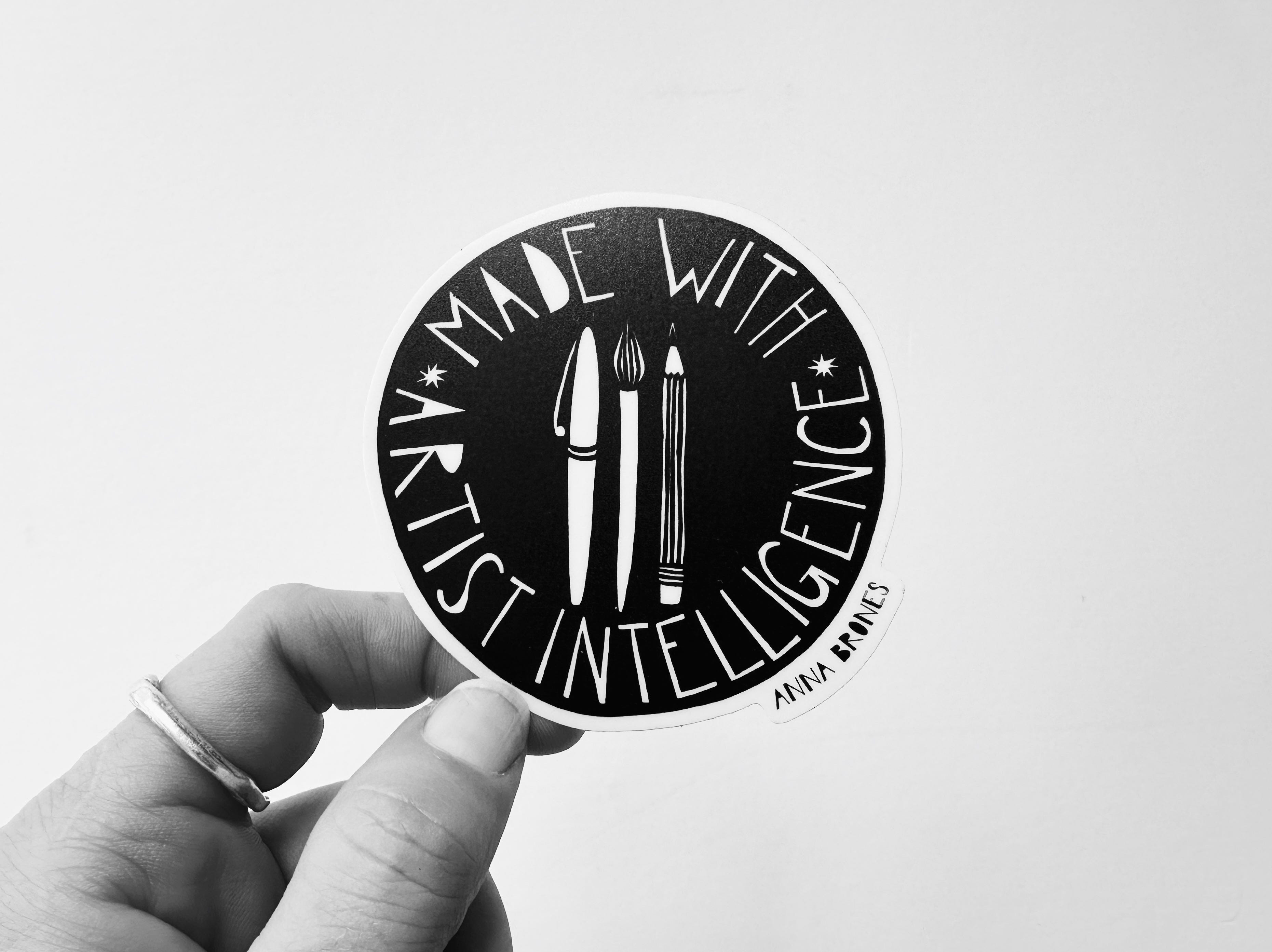
I finally made this papercut into a sticker. Paid subscribers: scroll down for a little discount code to get a free one.
Hello friends,
Before we begin: go pour yourself some coffee to have with this one. I need you to join me in caffeinated rage, and you’ll want something to sip on during this slightly longer piece.
While I was I helping a friend with a kids art project recently, one of the parents asked me what my definition of the difference between art and craft was. Great question. I gave some wandering initial thoughts and said I would keep mulling it over. One of the other parents said, “I would just ask ChatGPT.”
“Absolutely not!” I blurted out without thinking, absolutely zero sense of self-control. An emotional chord had obviously been struck. I felt bad about my delivery. I don’t want to be the person who judges how someone else explores their own curiosity. If that person is reading this, consider this my official apology.
I didn’t feel bad about the sentiment however. I tried to cover for myself, honor that for this person maybe that was the best way for them to consider a question that didn’t have an easy answer. In the same breath, I also tried to make my opposition clear. This of course led to being asked about my opinions on the AI controversy in art compared to the AI controversy in other industries.
Meanwhile the kids drew beautiful posters about trees and how we should care about the natural world.
I am not a technophobe. One of the places where AI has been really helpful for me is transcription. The amount of hours that would have been required to transcribe all the interviews that I have done over the past two years for book research, or even interviews featured in this newsletter, is incomprehensible.
In this case, that AI software has allowed for more time to go into other elements of creative work—writing, thinking, making art—and I am thankful for it1. I also still furiously scribble notes in my notebook while I am interviewing someone. Not surprisingly, these are often the things that stick the most in my head and that I remember weeks later. Writing by hand is great for memory after all.
With my own AI resistance (I’ve used ChatGPT once in my life, and only as an experiment), I often wonder if I am an analog stick-in-the-mud. Am I slowly creeping into that age where I don’t want to learn something new and end up stuck in a kind of fever induced nostalgia for the past while the rest of the world moves on? Should I just get on board and move on with it?
A few weeks ago I attended an online conversation between Ross Gay and Aimee Nezhukumatathil and the topic of AI came up. Gay started out with talking about loss. “The loss of our capacity to ask one another questions, the loss of our capacity to get recipes from people we love, the loss of our capacity to read a map… we have to do those things,” said Gay. “Know that at every turn, there’s going to be stuff… trying to interrupt our capacity to be with one another.”
He continued:
“We need to be together. We need to be in rooms together. We need to ask for directions. We need to be beholden to one another and practice being beholden to one another. To not be “independent”—you know, that miserable fantasy—but to in fact be interdependent.”
Nezhukumatathil pointed out that when it comes to the things she loves, “it’s always the opposite of what AI can do.” “I want nothing to do with that world,” said Nezhukumatathil, “I guess I’ll be one of those cutesy old ladies sitting on the porch, still writing with my pencil.”
I too want to be that woman gripping tightly to my freshly sharpened pencil which still smells of a world where real, tactile goods and experiences mattered.
“There’s nothing for AI that I want to even consider because I know how destructive it is to the environment. Here in Memphis, less than an hour away, is one of the biggest plants of it, and it’s—surprise—an economically depressed place full of African-Americans. That’s no coincidence that it was placed there,” said Nezhukumatathil, referencing Colossus, the AI supercomputer that fuels and trains Elon Musk’s AI chatbot Grok. “It’s poison, it’s just poison. Spiritually, physically, mentally, creatively a poison.”
The methane gas turbines (unpermitted, again: surprise!) of Colossus alone are responsible for a 30-60% increase in Memphis’ smog, and the facility uses enough electricity to power 100,000 homes. As journalist Ren Brabenec wrote, “these neighborhoods are beginning to look like ‘sacrifice zones,’ or poor, predominantly Black communities that are willfully poisoned and polluted for the interests of power and wealth.”
Nezhukumatathil’s most powerful response—which I wrote down in huge letters in my notebook and underlined so much that I could see the indentation from the pen on the other side of the page—was simple: “I refuse.”
This is a line from sociologist Tressie McMillan Cottom, who spoke about her refusal at a panel hosted at the Urban Consulate in Detroit last year:
“When people try to sell you on the idea that the future is already settled, it’s because it is deeply unsettled. I think that, y’know this promise of an artificial intelligence future, is really just a collective anxiety that very wealthy, powerful people have about how well they’re gonna be able to control us.
If they can get us to accept that the future is already settled, AI is already here, the end is already here, then we will create that for them. My most daring idea is to refuse. The proposal for a post-human future is one where there will be human beings who will just be treated inhumanely. We’re not going to stop making people or humans. They’re just saying we are not going to treat you as humans. And I refuse.”
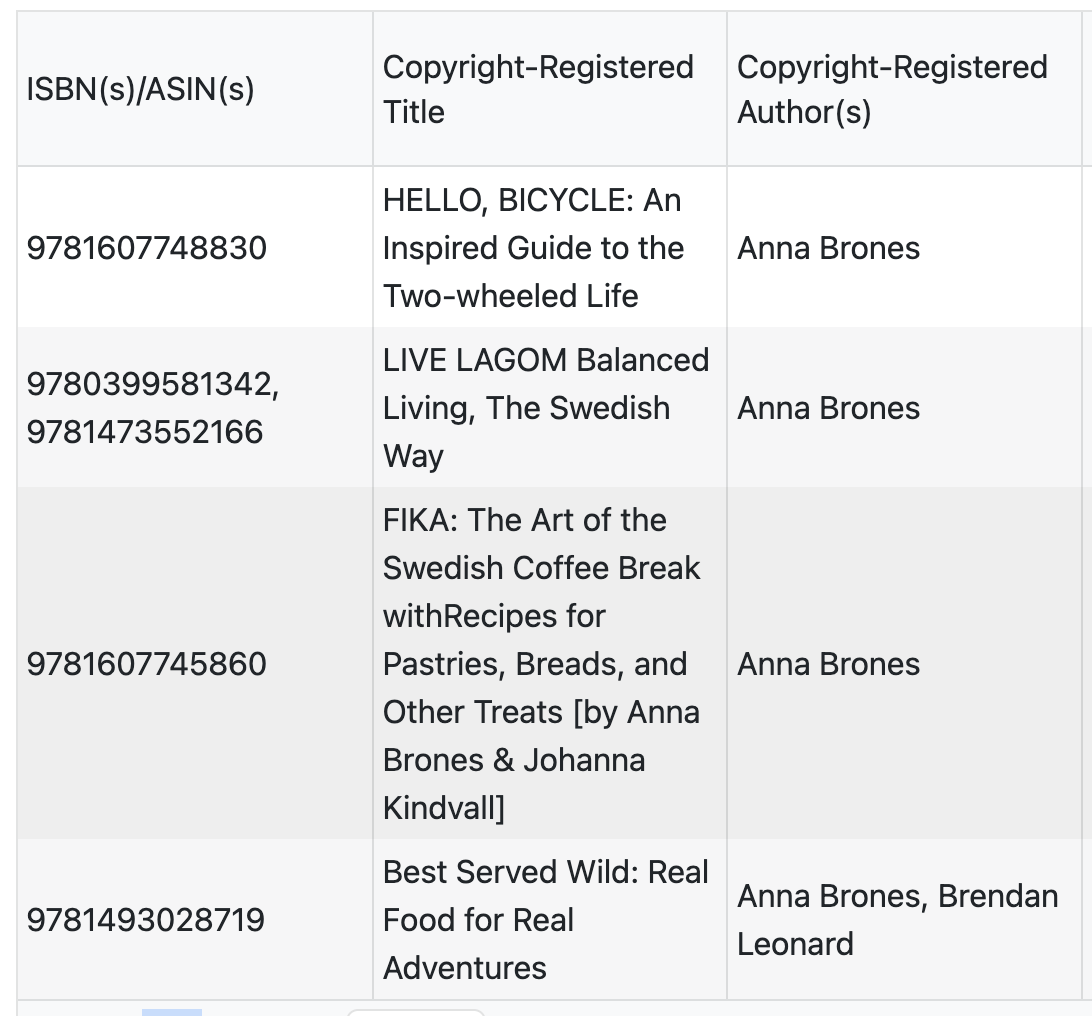
Four of my books are part of Bartz v. Anthropic, the historic copyright infringement lawsuit that was settled last fall. Around 500,000 books are involved, and the company is now forced to pay $1.5 billion as part of the settlement. It is the largest copyright settlement in U.S. history.
“The excitement of such a victory among those who write for a living is understandable,” writes Dan Cohen, in an excellent piece about the settlement and what it means for writers. “The AI industry is perhaps the most skilled player in Silicon Valley’s game of moving fast, breaking things, and not asking for forgiveness.”
It feels good to see one of these big companies get push back from the small guys and win right? Yet it’s a drop in the bucket. $1.5 billion might sound like a lot to a writer or an artist (that amount is basically monopoly money) but Anthropic can probably scrounge up that cash from under the couches at its San Francisco HQ. The company was recently valued at $380 billion, and for artificial intelligence companies, a couple billion dollars here and there, “may quickly become a marginal additional cost of doing business” writes Cohen.
A billion dollar slap on the wrist so to say, something you can simply turn into a line item in your enormous budget. But this isn’t just about money:
“The issue with AI is not that it uses the text of writers to train its models, which are, after all, just a bunch of inscrutable numbers and math that only AI researchers can appreciate. It is that these models are then used to generate new text that competes with the work of authors, whether they are writers of novels, news stories, or blogs, and worse than that, without crediting them. Human writers are used to other writers digesting and incorporating their work, and even adopting their ideas, but in return, they expect attribution. This is a long tradition that AI breaks. The Bartz settlement will allow this experiment in competing artificial authorship to continue apace, and perhaps even safeguard its future.”
Yup, like Cottom, I refuse.
I refuse to take part in a system that is actively destroying the human elements of our lives. I refuse to use something that slowly erodes my own mind and thinking skills. I refuse to wade around in entertainment slop. I refuse to view creativity as having one idea, plugging it into software, and seeing what comes out of it from the other side.
I asked around to some fellow writer friends for their opinions.
“AI is soulless,” says Emma Gannon. That’s because “writing is an inside job,” a kind of collaboration between you and the ether/source/universe, or whatever you want to call that energy that we’re all constantly trying to channel. She has spent a lot of time thinking about this topic in particular, as it’s the theme of her new book, Creative Compass, out later this year. Creativity is “deeply spiritual,” she says. “Working with AI/robots misses the whole point.”
Any artist or writer knows that creative work rarely begins with an elaborate and highly detailed idea. You usually start with a glimmer, something that sparks just enough curiosity to lead you to think, “hmm, that’s interesting, let me explore that.” Then you chase it. You get to work, making your way from that idea and into the murky terrain that lies between you and the unknown—often unexpected—outcome on the other side.
There are obstacles along the way. Plenty of blocks. Usually some crying. But there are also revelations, new things learned, epiphanies, moments of flow. This whole process with all its ups and downs is where the good stuff lies.
As Daisy Buchanan puts it:
“I want writing and creativity to feel fun, nourishing and joyous. However - I think we get to fun, nourishing and joyous by travelling through passages of panic. I was just talking to a friend about Michelangelo saying ‘I am no painter’ while he was in the middle of painting the Sistine Chapel. I ached for him, I felt as though he’d reached across centuries to squeeze my hand because that’s exactly how I feel in the middle of a novel draft, if you swap out painter for writer… the magic, and the deliciousness, of all art is in the unknowing, the stumbling, discovery and the strange. AI smooths a path that shouldn’t be made smooth. It’s a motorway/freeway in the middle of a forest. It may make it easier to get to where we think we want to go, but we can’t get close. And we can’t be surprised, or decide to change our destination on a whim.”

“I just don’t understand the point of using AI,” Katherine May told me. “Creative work is a thought process, and if you skip that, you’ve skipped the chance to think. It not only breaks the unspoken contract between the writer and their readers; it breaks the contract between the writer and the writer. We got into this because we wanted to make work! Not because we wanted to be word factories.”
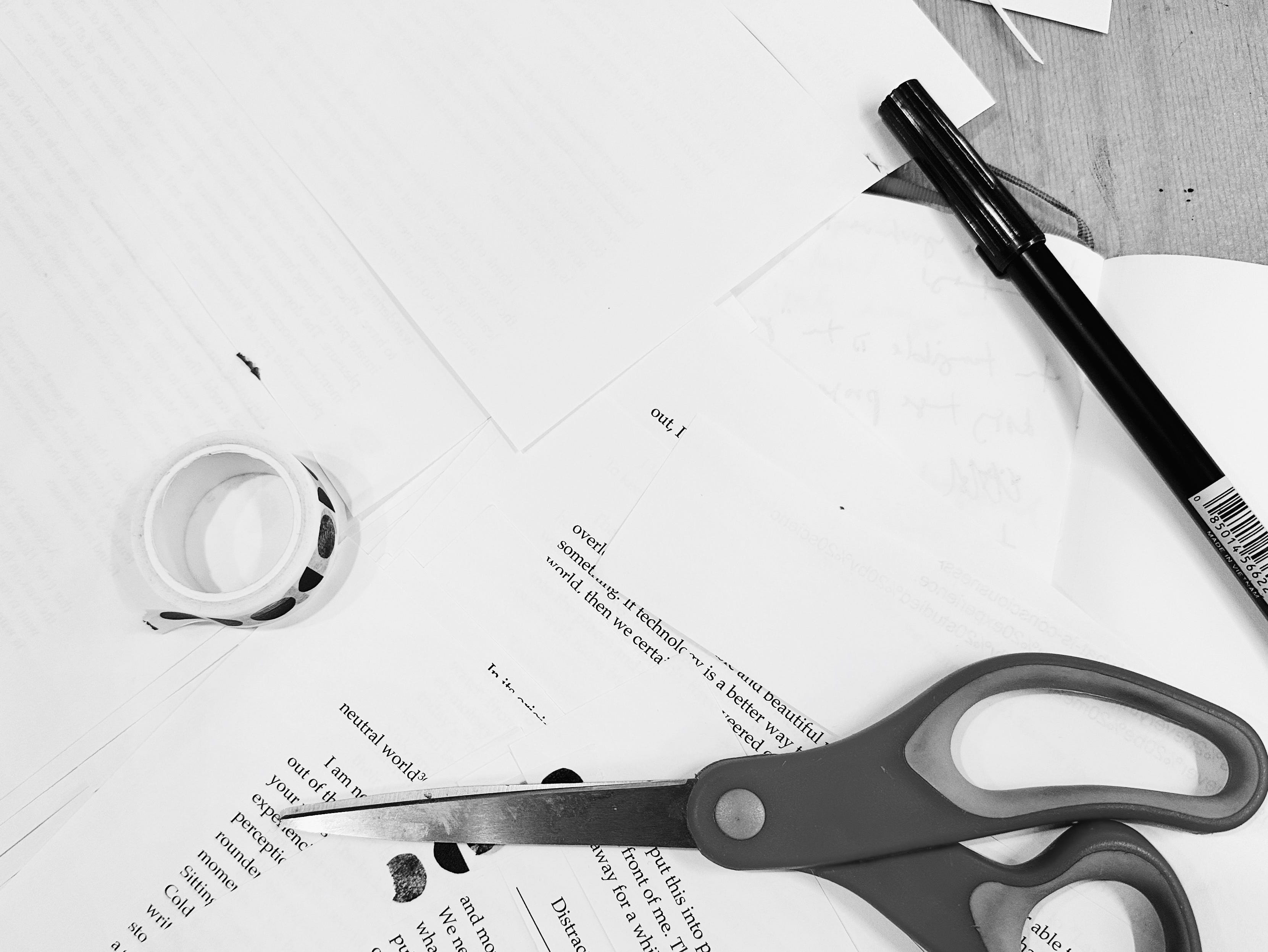
This week as I worked on my book draft, I printed out a chapter and physically cut it up into pieces, then used washi tape to put it back together in a different way. For my brain, this was easier to do by hand and in more of a collage way than moving things around on the screen.
That kind of activity is fun, but it also feels like a tiny act of rebellion. Like Katherine, I refuse to be a word factory. I refuse to be an art factory. The creative work takes the time that it takes. It has to go through the slow process in order to get wherever it’s going. I refuse to have the process optimized.
“Writing is about actually writing, not trying to skip over writing. If people want to skip the writing process, maybe try another art form?” Caroline Donahue told me. “I feel like AI is often an attempt to be a writer without actually writing, but this is never satisfying. AI should not be a way to avoid the mechanics of writing, other than perhaps grammar and spellcheck. If AI is replacing imagination as an ideacheck, we will have nothing meaningful to read in the future.”
I also like how writer Tochi Onyebuchi puts this:
“The lie I hear spoken by every image-generation or video-generation or text-generating Gen AI app is the lie of instantaneity. That the most important thing is having produced. Not the living that precedes the act of art-making, not the living that occurs during the art-making itself.”
Or this line: “So much harm feels and is so immediate right now. Fascistic creep bubbles like lava through the crevices of America’s political and cultural substrata.”
This isn’t just about some artists and writers clinging to their beloved creative process. This is also about an entire restructuring of society.
I refuse to use something that disconnects us from our humanity, that helps to make war attacks go “faster than the speed of thought.” I refuse to accept a system where we erase a significant chunk of the workforce, all in the name of wealth at the top and a “just figure it out” for everyone else.
Sam Altman and his “little group chat with my tech-CEO friends” is betting on the date where a billion dollar company survives with just one person. They’re pretty much lusting for when that day comes. You don’t need to be an expert at economics or math to understand that on a societal level, where everyone needs to be housed, eat, and have healthcare, this equation does not play out.
We are going to have to entirely rethink and restructure the labor and labor training market. There are already signs that white collar workers are increasingly eyeing skilled trades as a fallback plan for when their jobs evaporate. I had this exact conversation with a friend yesterday, who has decided that becoming an electrician might be the way to go.
Speculation on what this all could actually look like in the near future was covered in an essay last month that went viral enough that it led to a tech sell-off in the financial markets. As Rosie Spinks wrote this week, “This is just a thought experiment and there are all kinds of variables that could prove it off base. But I find it notable that these authors caused such a ruckus simply by plainly articulating what the logical end point of this extractive system is. This really isn’t some big plot twist.”
No, it’s not. Some of us have been reading this book for a while now and would love to just put it down without getting to the end, crossing our fingers that it goes out of print soon and is never sold again.
While thinking about my own resistance to AI, the term “luddite” came to mind and I was reminded that “what concerned the Luddites about technology was that it was going to cut their wages.” Sound familiar? Even in the industries where AI has been promised to lighten the load, some workers are now suffering from what’s being called “AI brain fry,” basically AI exacerbating mental fatigue instead of helping with it. As one engineer called it, “cognitive overload masked as productivity.” So it will make you feel worse before it inevitably takes your job? Great.
I’ve always joked that whenever I hear “LLM” (large language model), my brain interprets it as MLM (multi level marketing). For the most part, AI does feel like a pyramid scheme.
Or as Rebecca Armstrong puts it:
“Generative AI, at best, is like eating frankfurters. So smooth! So featureless! So easy! But we don’t see the true horror of what makes the frankfurter so smooth, nor where the “meat” comes from. Using it, at best, is lazy, shortsighted, and a betrayal of true creativity. At worst? Criminal. It’s stolen material squished together to make a hotdog garnished with planetary destruction (let’s call it the ketchup) and the support of monstrous power mongers (mustard?).
Leave it to a visual artist to give the best description.

I take comfort and solace in my fellow artists and writers who are adamantly refusing this world. “Writing is to think and discover and create something new and surprising both to writer and reader,” Freya Rohn told me. “AI is just churning out what’s already been said. There isn’t any real discovery or creation or thinking involved. if we’re not thinking for ourselves what are we doing?”
Unlike Altman’s, my little group chats are filled with links to articles about how you can’t be sexy if you use AI, simple yet radical inspiration from Ursula K. Le Guin and Tove Jansson, and how much we love any kind of unhinged creative project that’s done just for the pleasure of it (I am looking at you lobster onesie).
Can’t we all just “move slow and make things?” Or fix things, tend to things, grow things, collaborate on things? What about “move slow and be human”?
As I was putting the finishing touches on this piece, Ella Frances Sanders’ newsletter landed in my inbox, titled “I’m Interested in Being a Person,” poetically covering a lot of the same anger, rage, and frustration that I’ve been feeling brewing lately. Which is to say: if you’re feeling it, you’re not alone.
AI is all around us, I know that it will be a part of our lives whether we choose it or not. But that makes it all the more important to actively resist it when I can.
Carve out the spaces where AI doesn’t get to enter. Preserve our humanity by continuing to do the things that we have done across our entire human lineage: be together, share stories, knowledge, and wisdom, take time to make things.
-Anna
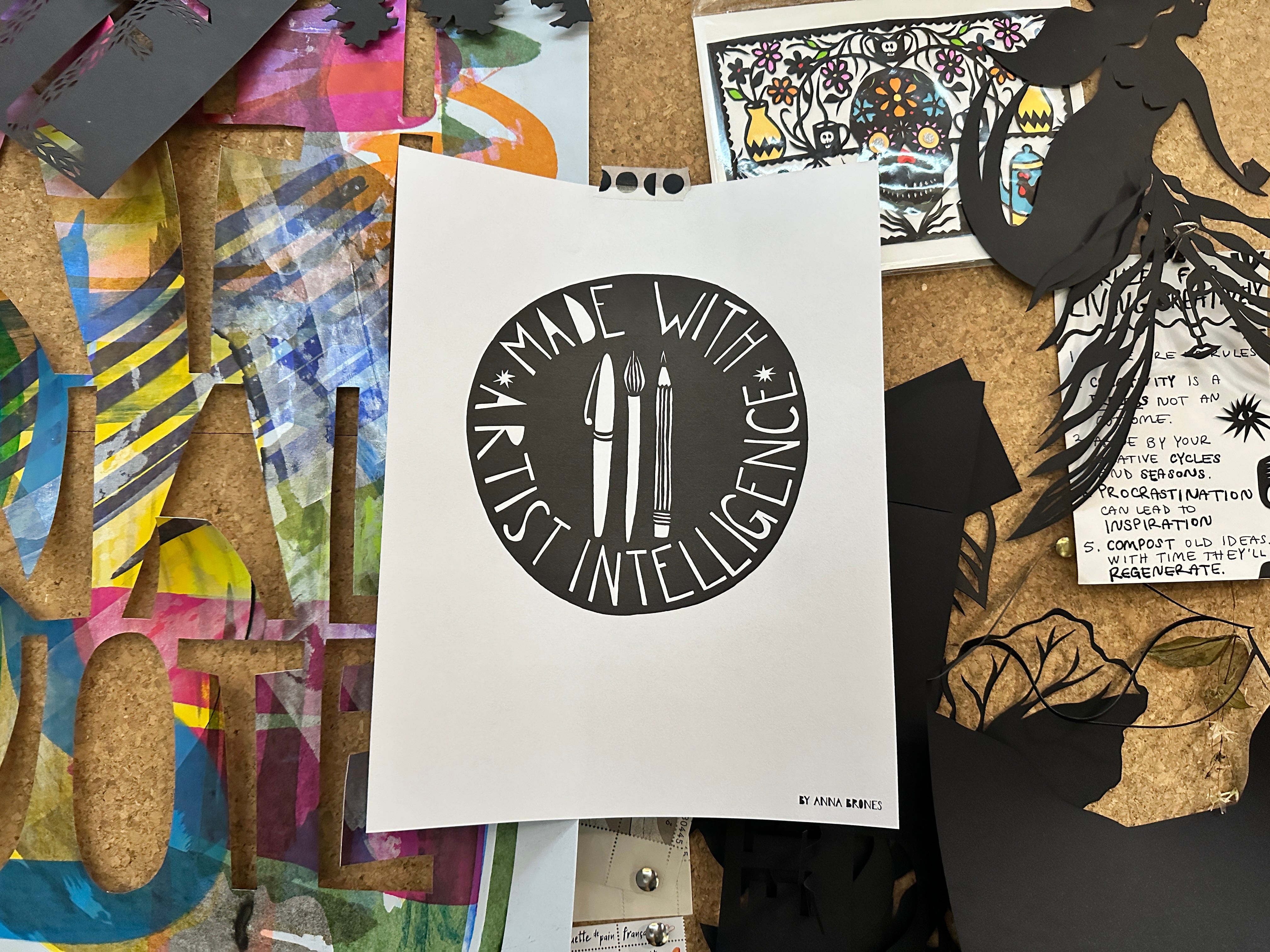
I finally turned the “Made with Artist Intelligence” papercut into stickers! They’re my little way of taking a stand against AI, or at least embracing a different kind of AI.
I keep almost all of this newsletter free and open to everyone to read. This only happens thanks to paid subscribers who allow me to take the time to write and make art. Sometimes you all need a little thank you and this is it!
You will find a discount code below for a free sticker (well free-ish, I still need you to pay shipping). And because I don’t ship internationally, I also made you all a little pdf that you can download, print, and hang in your studio as a poster.