

In Our Hands
Offline refuge.
Some new cards dropped this week in the shop. Like a nice coffee sunrise and a night swim // Tacoma+Seattle friends: put July 18th on your calendar. I am collaborating with my friend Christie at Moon Mountain Farm on an in-person workshop that involves the photo above, details and signup coming soon!
Hello friends,
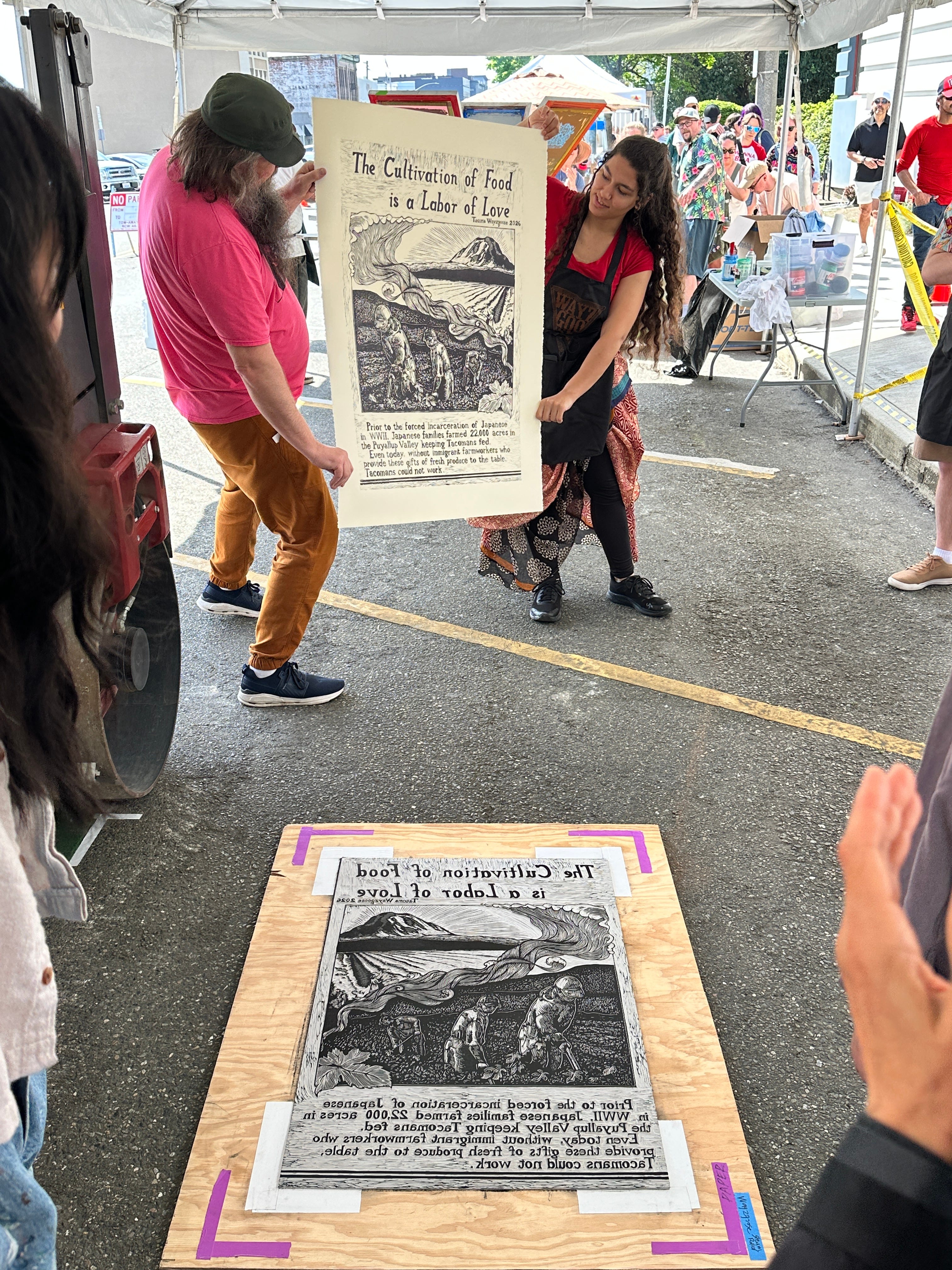
A couple of weekends ago I went to Tacoma Wayzgooze, an annual community letterpress, printmaking, and book arts extravaganza. The main selling point of the event is seeing artists ink up enormous linocuts that they have carved, and then watch as a steamroller goes over them to make the print. The paper is pulled off the linocut and everyone cheers.
Hosted at the main library, the upstairs was packed to the brim with local printmakers and artists. An uplifting scene, so many people in one place devoted to bringing creative ideas to life. If you ever need a pick-me-up, it’s best to find your way to any gathering where people are hellbent on making things.
According to the International Printing Museum, Wayzgoose is:
The name for a celebration given by a master printer to his workmen each year on or about St Bartholomew’s Day (August 24). This marked the traditional end of summer and the point at which the season of working by candlelight began. Later, the word came to refer to the annual outing and dinner of the staff of a printing works or the printers on a newspaper.
Among other things, Saint Bartholomew is known as the patron saint of leatherworkers, bookbinders, and shoemakers. Professions that require skilled handiwork. Actual hands. That’s what the word dictates after all. From Old English handgeweorc, the “work of the hand, creation.”
As if our hands and bodies could ever really be separated from the work that we create.
Even in language—what most of us would consider an activity of the mind—the hands and body are involved.
The “hand and mouth are really linked at some very early age. When babies talk, they also move their bodies and they move their hands,” says Susan Goldin-Meadow, Beardsley Ruml Distinguished Service Professor in the Department of Psychology at the University of Chicago.
We continue to do that as adults. Gesture has been shown to impact our thinking. Moving our hands takes our thoughts out of the abstract and helps to make them concrete.
Goldin-Meadow has spent her career investigating exactly this, looking at gesture, language, communication, and ideas. They’re all connected. “Our hands really are a source of information about our minds,” she told an interviewer.

I was thinking about this as I had my book draft printed and spread out all across my desk this week. I’ve been tasked with restructuring it, and I am incapable of doing that kind of work on a screen. For me, this is only possible with analog methods. I have to use my hands, spread out all the pages like it’s some kind of map.
There are handwritten notes in margins, post it notes stuck up on the wall. I even went so far as to buy an enormous pad of easel board paper that I can stick to the wall, making the studio look like some scene out of a crime show where detectives are trying to connect the dots.
When I am writing and stuck on an idea, I often find it easiest to stand up and walk around the studio. I will even gesture with my hands to try to encourage a sentence to make its way out and onto the page.
This hand/mind connection has been shown in other ways. When it comes to learning and retaining information, writing by hand wins out over typing. And while Grit Matthias Phelps, a German language instructor at Cornell University, was inspired to go out and buy used typewriters for her students because of a growing frustration with generative AI, I can’t help but wonder what the physicality of tapping on the keys does for the brain.
“Everything slows down. It’s like back in the old days when you really did one thing at a time. And there was joy in doing it,” Phelps told the Associated Press about her students using the typewriters. As one of them pointed out:
“It dawned on me that the difference with typing on a typewriter is not just how you interact with the typewriter, but how you interact with the world around you. While writing the essay, I had to talk a lot more, socialize a lot more, which I guess was normal back then. But it’s drastically different from how we interact within the classroom in modern times. People are always on a laptop, always on the phone.”
Even when we’re at work with our hands, we’re still paying attention to what’s going on around us, can still engage.
At Wayzgoose, there was a person sitting at a table with a typewriter, writing poems for anyone who wanted one. An “on the spot poet” as the sign for Ultra Violet Poetry said.
She asked me for a word or theme for my poem. “Saltwater,” I said, the first thing that came to mind. She sat there and began typing. There wasn’t much pausing or correction. It was if the words just flowed out of her.
When she handed me my poem and I read it, my first thought was “how did she know?” because the poem felt so personal, so pointed, that it was as if she had swam around in my own mind and pulled out what I needed to hear.
I watched as she wrote poems for other friends. They too got the words they needed. Was it the physical movement required at the typewriter that had allowed her to tap into her own creative subconscious?
Whatever it was, it was nice to hold a poem in my hands.
Working with our hands is uniquely gratifying in a way that simpler, less intricate tasks—like clicking and tapping—just aren’t. But there’s something else about using your hands that is playing a role in how we feel when we work with them: our hands are our access point to the real and tangible.
Increasingly, that’s something that more and more of us are after.
I recently ordered a copy of Quiet Media, a zine by Quiet Media about attention. Like most things, I read about it online, but I didn’t necessarily want to learn too much about the how and why behind it. Instead, I wanted to sit with my cup of coffee and flip through the actual pages.
Working her entire career in advertising as a communications strategist, editor Charlotte Rubesa writes that in her industry, “the pursuit of resonance turned into the less noble one of reach.”
I can feel that even in my own work sometimes, and I hate it! The good news though is that many of us have had enough. “For the first time I see people actively, en masse, reclaiming their attention and rejecting the rules of digital media. We are overstimulated. Our feeds are oversaturated,” writes Rubesa. “And as a result we’re turning away.”
I see this amongst my friends, I see it amongst my creative acquaintances. We’re trying to find our way back to something slower. Somewhere we can take a breath.
In a piece titled “Inside the Slop Machine,” contributor Michael Goldstein writes:
“Offline is a final refuge. Real life can’t be clipped. It’s where attention is earned, not engineered. To call offline a form of disconnection assumes the online feed is connection’s default. It isn’t. Offline isn’t withdrawal; it’s the possibility of unfiltered joy, even hedonism, where curiosity is rewarded and meaning arrives whole. Where clipping is compressed production, offline is the live performance.”
When we hold something in our hands—whether it’s a book, a pencil, a flower, a vegetable—we don’t have to ask ourselves if it’s real or not. The weight, the texture, the pressure of something tells us that its existence is not just on a screen or in a digitally generated delusion. It is right there in front of us.
I find myself keeping a running list in my head about everything I have done with my hands.
Just this week:
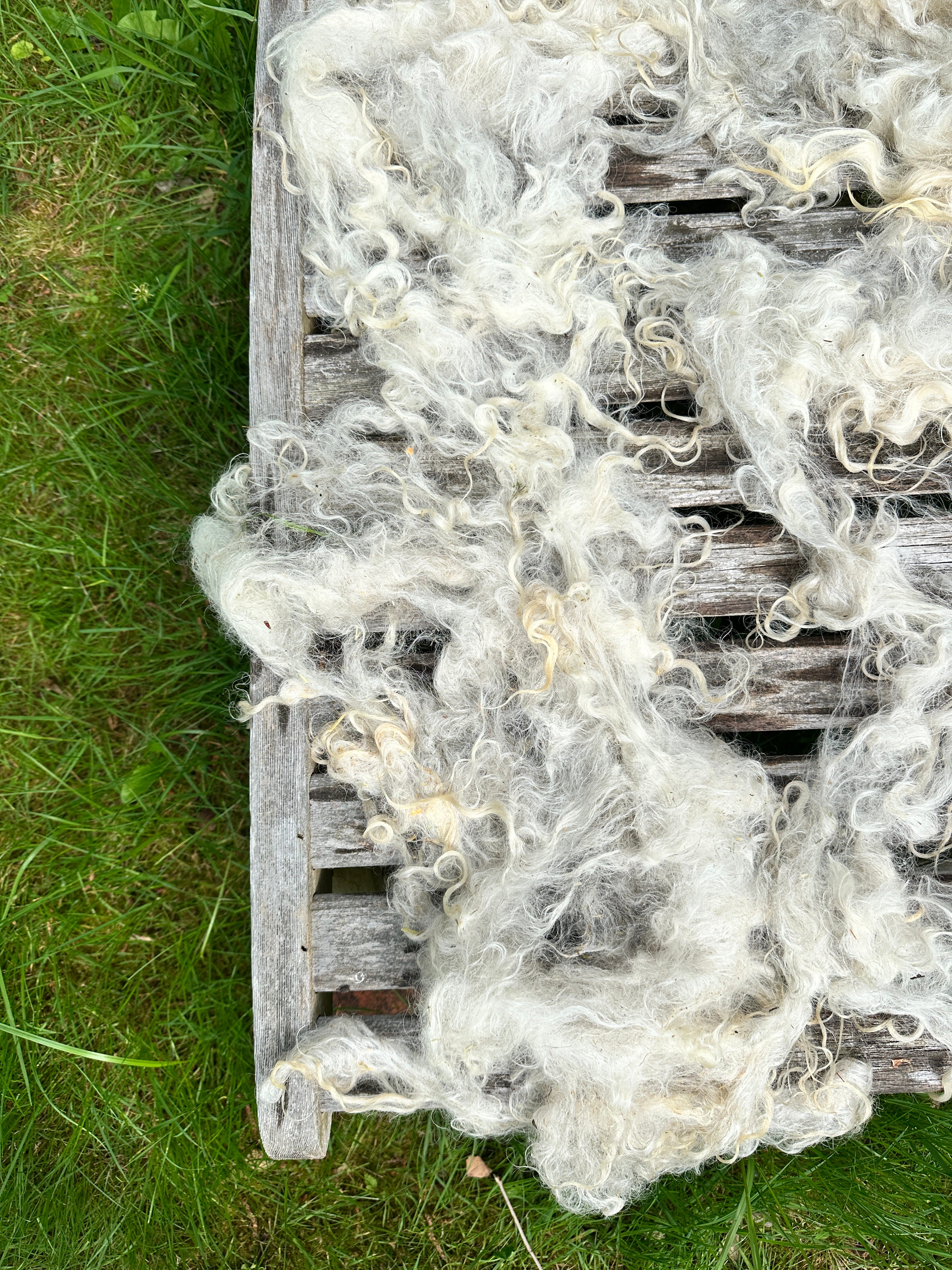
A bag of raw fleece, freshly shorn from a local sheep and left on my doorstep as a gift. My mom and I washed it outside on a sunny day, the lanolin leaving my hands soft.
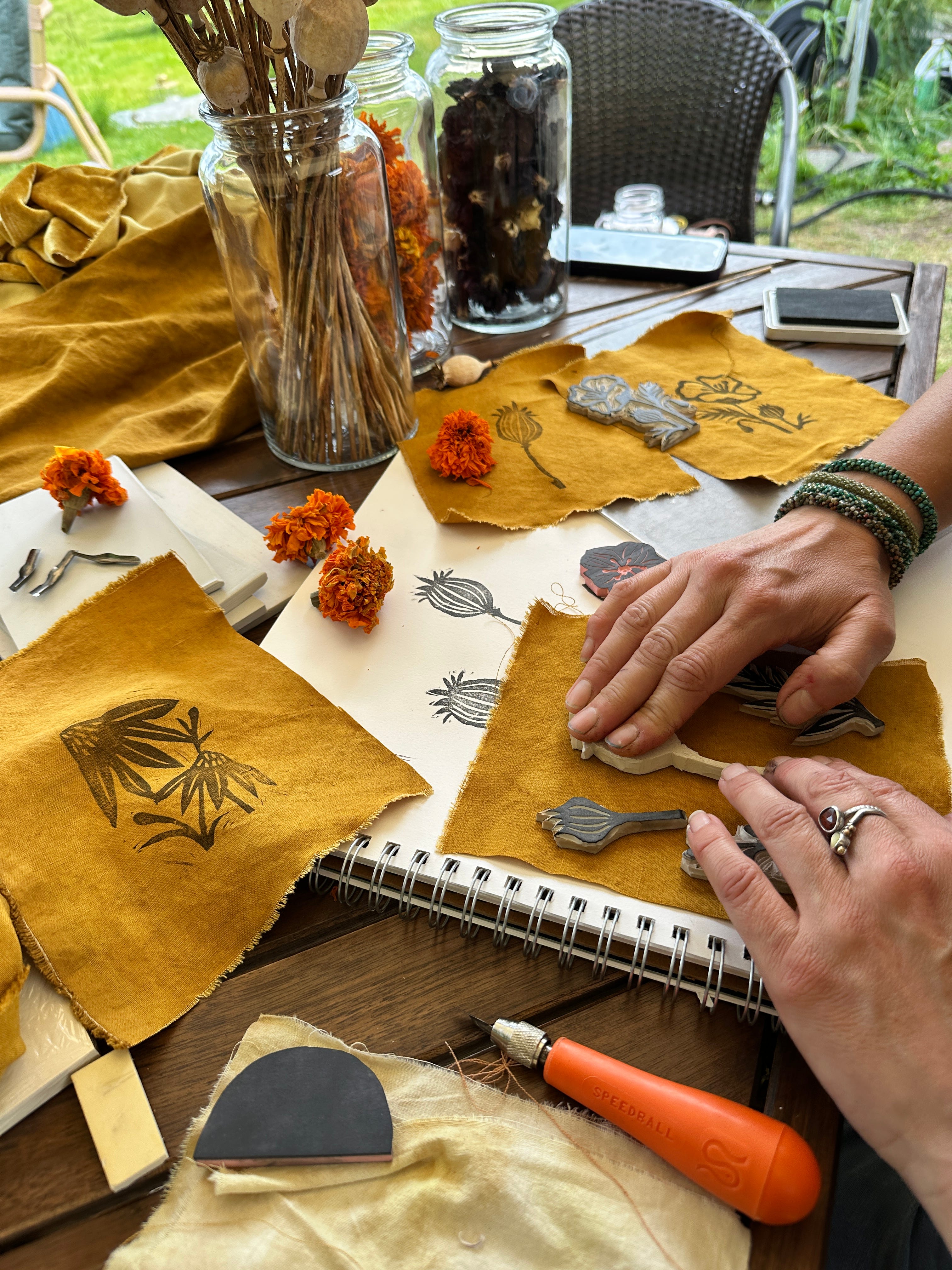
Cutting a stamp to print onto fabric. My fingers stained with black marks after the endeavor.
All the pens held: the black brush pen, a pink felt tip marker, a blue pen that clicks open and closed.
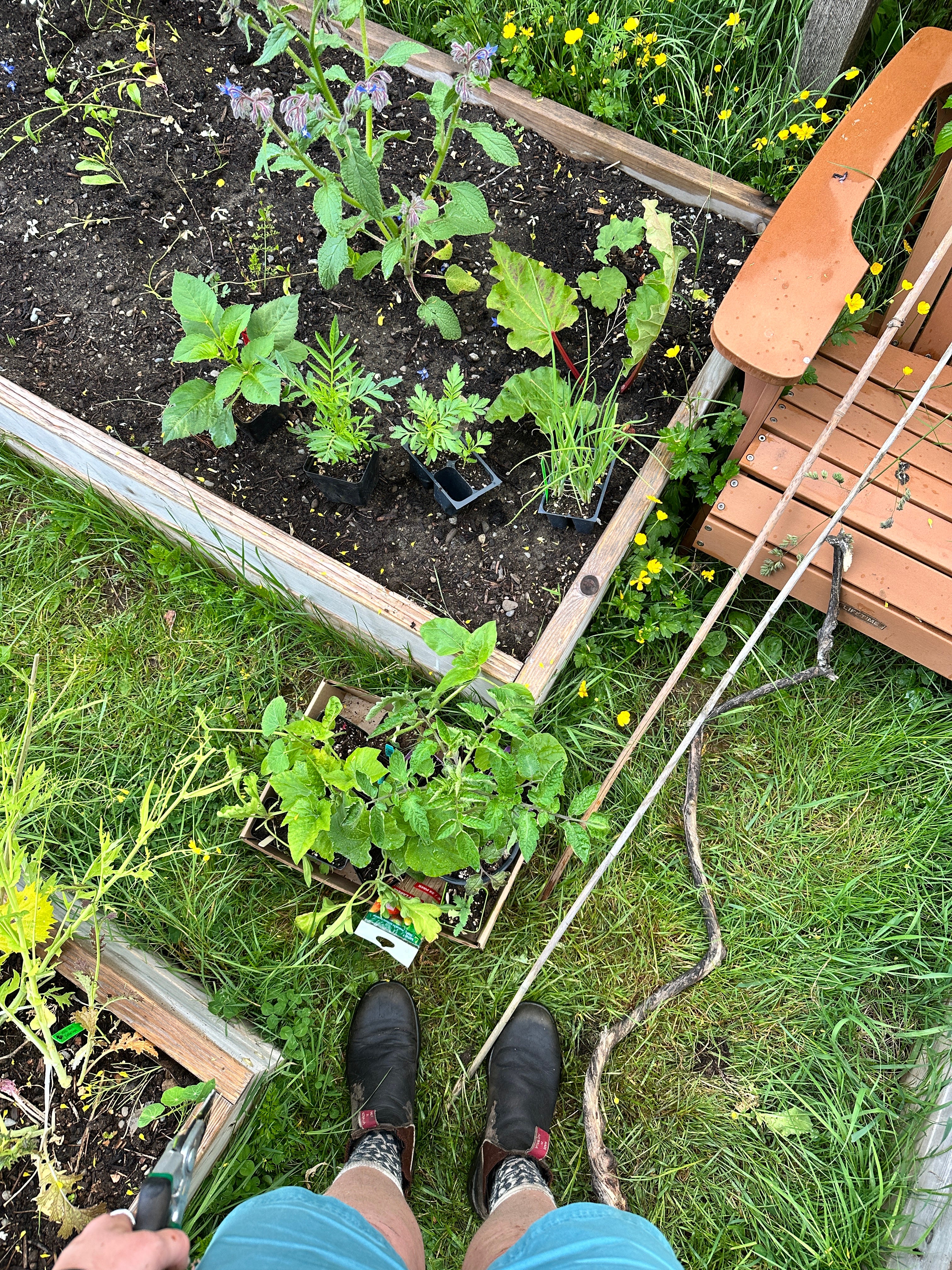
Constructing a bamboo trellis in the garden. The feel of twine across fingertips. Hands covered in dirt from digging the tomatoes in.
Pulling black booties off and on at the boat launch. Fingers a little stiff even an hour later. A reminder that even in May, the water is still cold.
All of it a refuge.
-Anna
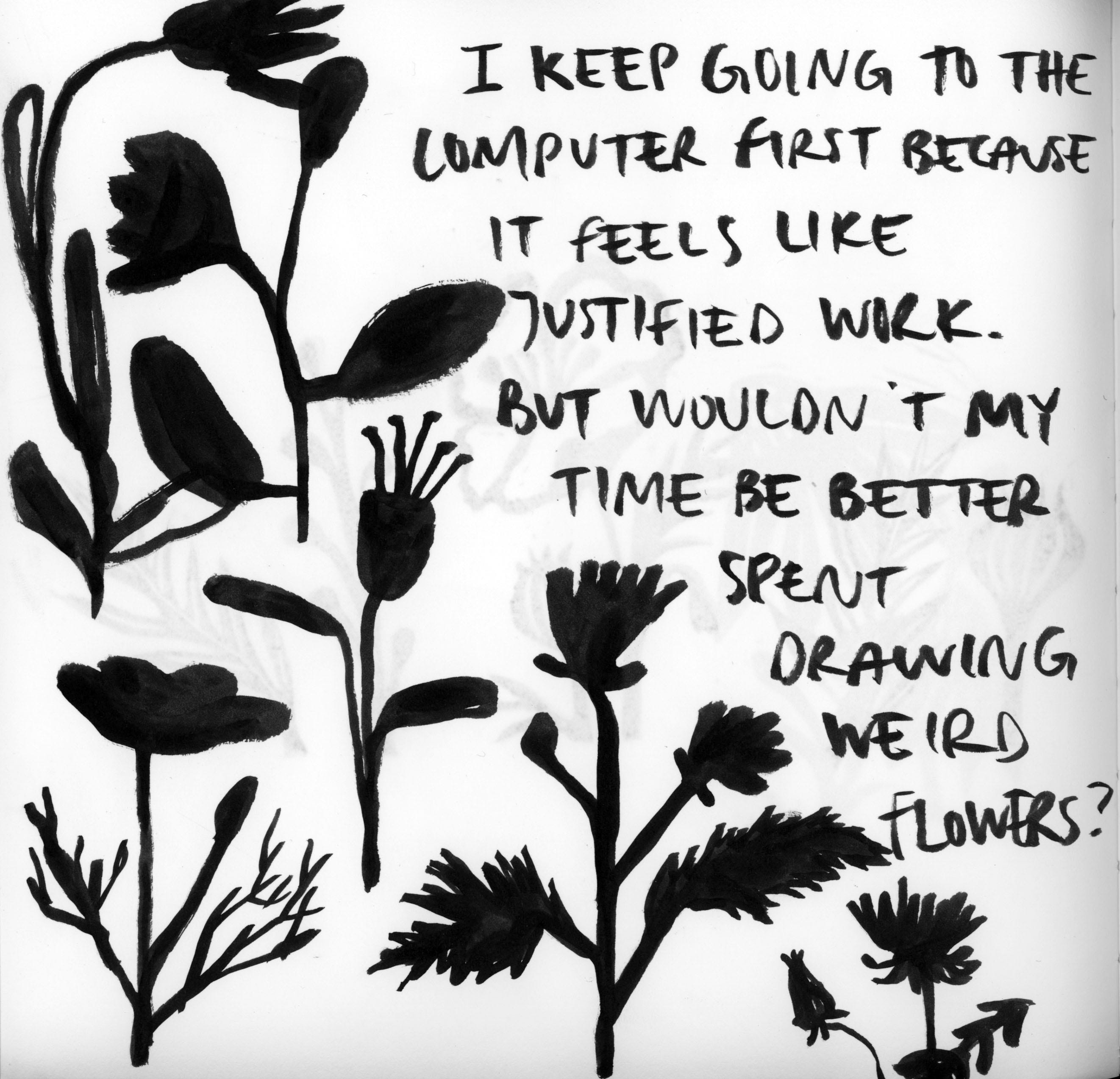

I made this sketchbook page as a reminder to myself, but maybe you need it too?
Official orders: Sketchbook or notebook first thing. The computer can wait!
And since so many of you were excited about the creative advice from my mom last weekend, I think you’ll love this little note of hers that I found yesterday while working on today’s newsletter.
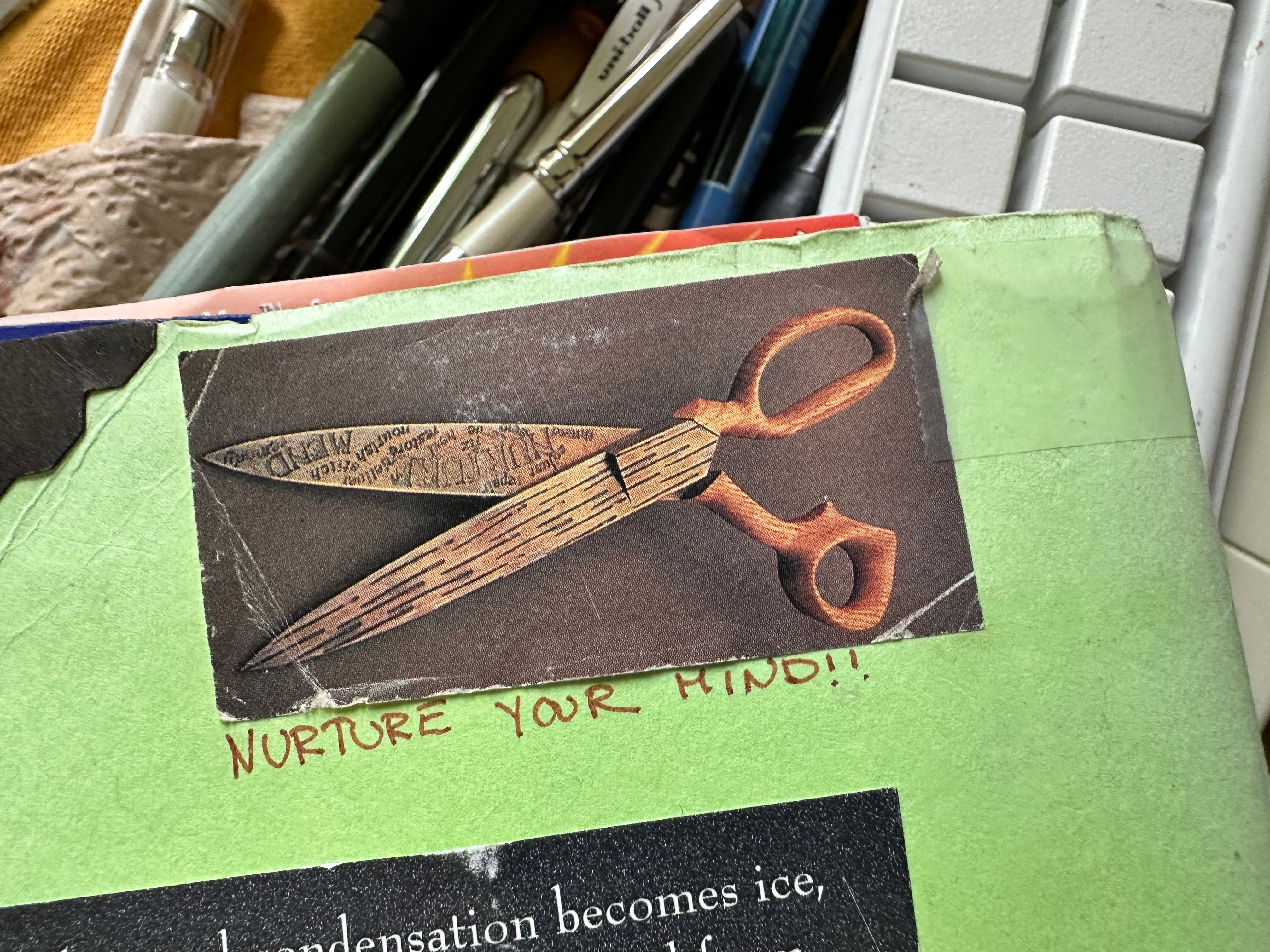
Nourish your mind! By using your hands of course.

Thank you, Anna. I needed this!
This reminds me of that picture we took, coming out of the salt water in which I had exclaimed, “Just think! We could be on the Internet right now! And you scrawled that text over the photograph in the most beautiful way. I think about it all the time.