

Changing Time
A silly pursuit.

Registration for the 2026 Singla Creative Retreat opens today! // The holiday season feels far away, but now is a great time to order a 24 Days of Making, Doing, and Being Advent calendar deck.
Hello friends,
At 7am on a late autumn morning, the sky is incredibly dark. Meeting at the boat launch to go in the water, the sunrise is around the same time that it will be at winter solstice. Red begins to touch the clouds, then turning to pink, casting an autumn spell across the morning sky. Even though there are still remnants of orange and yellow in the trees, at this particular moment, this does feel like the dark of winter.
If you’re reading this in the U.S., the clocks will change this weekend, and next week my morning dip will be graced with a little more light. I’ve held off on bringing the neoprene booties back out after a long summer seasons stashed in a box, but the water has officially begun its shift towards winter. After a few prickly mornings, I’m finally in need of that feeling of wearing wool socks in water. It’s a seasonal change, less dictated by a calendar or a schedule, and instead by a physical feeling.
The clocks however are different. That’s dictated by law. It’s a strange thing to change time, a human attempt at controlling something that that so clearly cannot be controlled. The sun will rise when the sun rises, the sun will set when it sets. All we can hope is that the cycle continues tomorrow.
I’ve always cynically thought of Daylight Savings and its commercial roots—extra daylight at the end of the day was supported by an assortment of lobby groups. More daylight meant more spending time. Time is money after all!
But then I read about George Hudson, who is known to have made the first realistic proposal for changing the clocks. As a preteen, Hudson moved from London to New Zealand. It was the late 1800s, and Hudson worked at the post office. In his free-time, Hudson was an amateur entomologist, fascinated by the world of moths and butterflies. Time outside of work at the post office was spent collecting and illustrating insects, resulting in the publication of his first book at the ripe old age of 19.
Hudson, like so many of us over a century later was confronted with the annoying reality of work and creative passions: there was not enough time in the day to do it all.
But what if you could change time?
Hudson pitched the Wellington Philosophical Society on a radical idea: set the clocks two hours back during summer so that there would be more daylight in the evening. Enough time for work during the day, and enough time to indulge in his love of moths and butterflies in the evening. His proposal was deemed “unscientific and impractical.”
The eventual move to changing the clocks was because of a wartime effort to conserve fuel, the U.S. adopting the law to establish daylight savings time in 1918. But it’s clear that the thinking about it even at that time was through a productivity lens.
Here’s a newspaper graphic trying to explain the change to people:
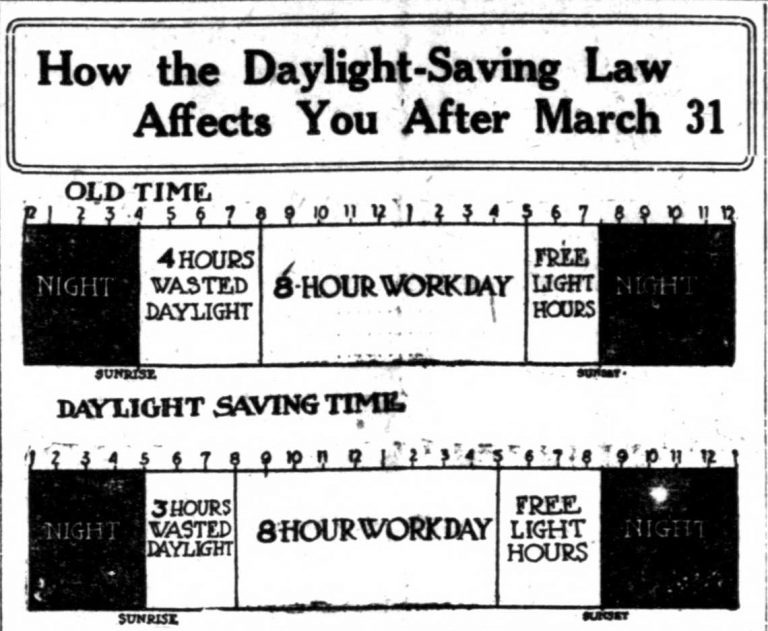
I think about what summer would feel like without daylight savings time. When the sunrises and sunsets would occur, what the beginnings and ends of the day would feel like. Trying to do the math always trips me up, no matter how many times I’ve memorized “spring forward, fall back,” so I like the idea of never having to think about it again. Time is a social construct anyway.
When the American railroad industry pushed for a common timetable in the late 1800s, thereby overturning the local time kept by cities, people weren’t thrilled. Big Time I guess you could call it. As one newspaper wrote: “Let the people of Cincinnati stick to the truth as it is written by the sun, moon and stars.”
I too would like to abide by a schedule written by the sun, moon, and stars. But I wonder what that would do for scheduling Zoom calls or managing deadlines. Not great. A common understanding and application of time is useful in our modern age. But I still think we’d feel better if we paid less attention to the numbers on a clock or the days on a calendar and took more cues from the natural world instead.
Even our earthly idea of time has its limits. At the edges of the universe time starts to run in slow motion. “Cosmological time dilation” is a thing, and while it’s one of those concepts that feels too mind-bendy to me to fully comprehend, I like knowing that time is far less concrete than we think it is.

As I finish writing these words on a dark and rainy Saturday morning, the light has gradually crept in. Leaves from the chestnut tree across the street are falling off one by one, blown away in the wind. If I avoid looking at the clock on my computer or the one on my phone, I can guess the time of day simply by what is happening in the sky. The rain darkens, there is no color or glimmer of light in the sky, unlike the striking sunrises of the past few days. But I still know the day is ahead of me.
The line from Mary Oliver’s poem “To Begin With, the Sweet Grass” comes to mind here: “eventually tides will be the only calendar you believe in.”
Even if we believe in that calendar, there’s still not enough time for all that we want to do. Instead of weeks, how many tides does a lifetime hold? What will take place in the midst of all of their ebbs and flows?
I wonder how Hudson would feel today, how he would try to manage his own creative pursuits in the midst of all the other demands. How would he squeeze in time for his beloved moths and butterflies? Would he slow down, would he avoid checking his phone? Would he feel pressured to share his insect illustrations on social media and then be annoyed that he had spent more time thinking about marketing his work than actually making his work? Would he wonder at the beginning of every new month where has the time gone?
I assume that he too would quickly realize that even if you change the time, even if you attempt to bend it to fit your needs, time continues on. There is never enough of it. Always more that we could do.
Best to watch the butterflies, the wind in the trees, the raindrops on the window while you can.
-Anna
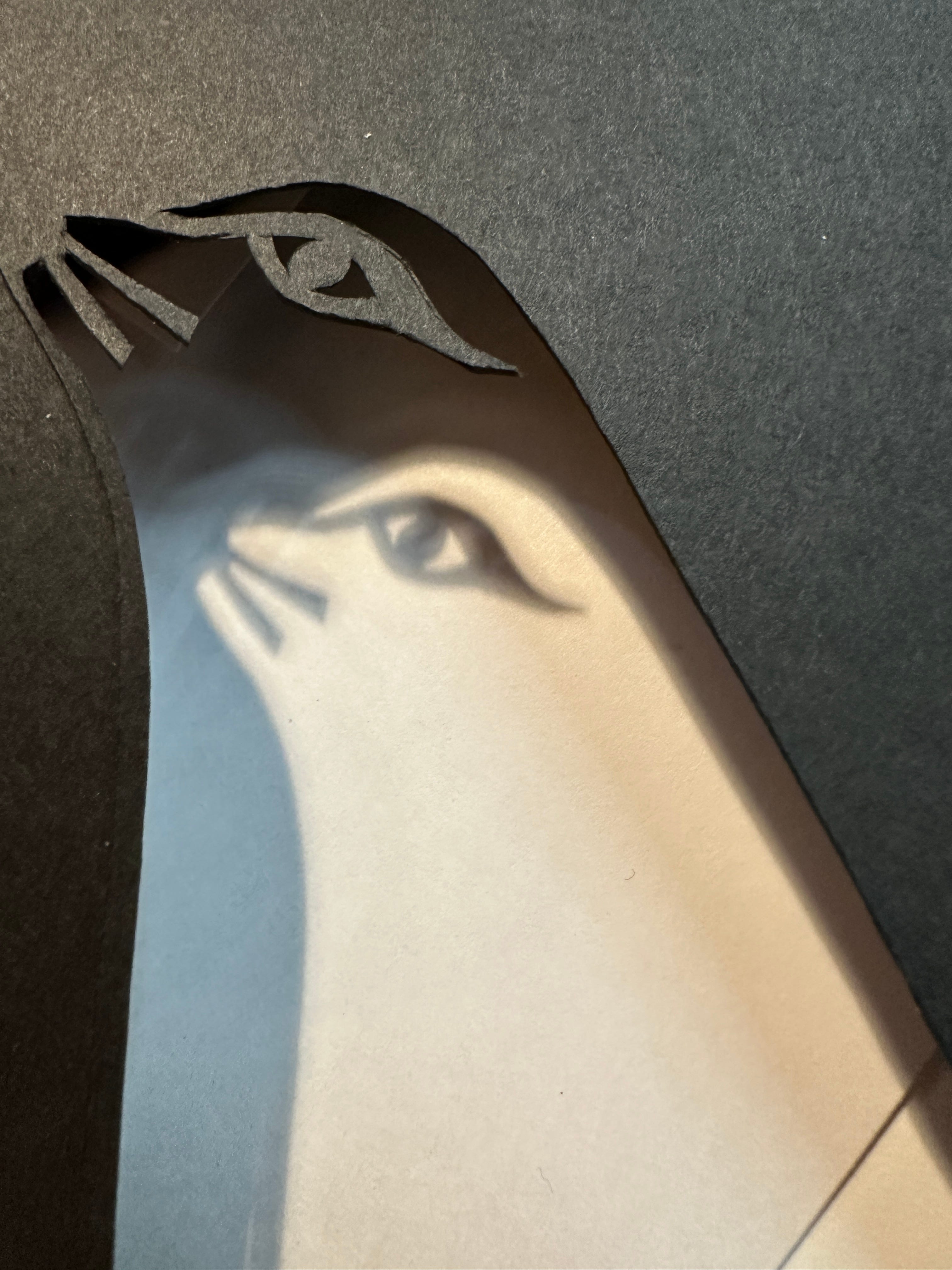
Ireland instituted a basic income program for artists. “This scheme is the envy of the world,” said Patrick O’Donovan, Ireland’s current culture minister.
Prodigy + Enya - the mashup you didn’t know you needed.
Halloween is over so you don’t necessarily need a costume but you might still want some of Jessie Kanelos Weiner’s printable Louvre jewels to wear around for fun.
I bought this calendar and very excited about it.
2026 SINGLA CREATIVE RETREAT
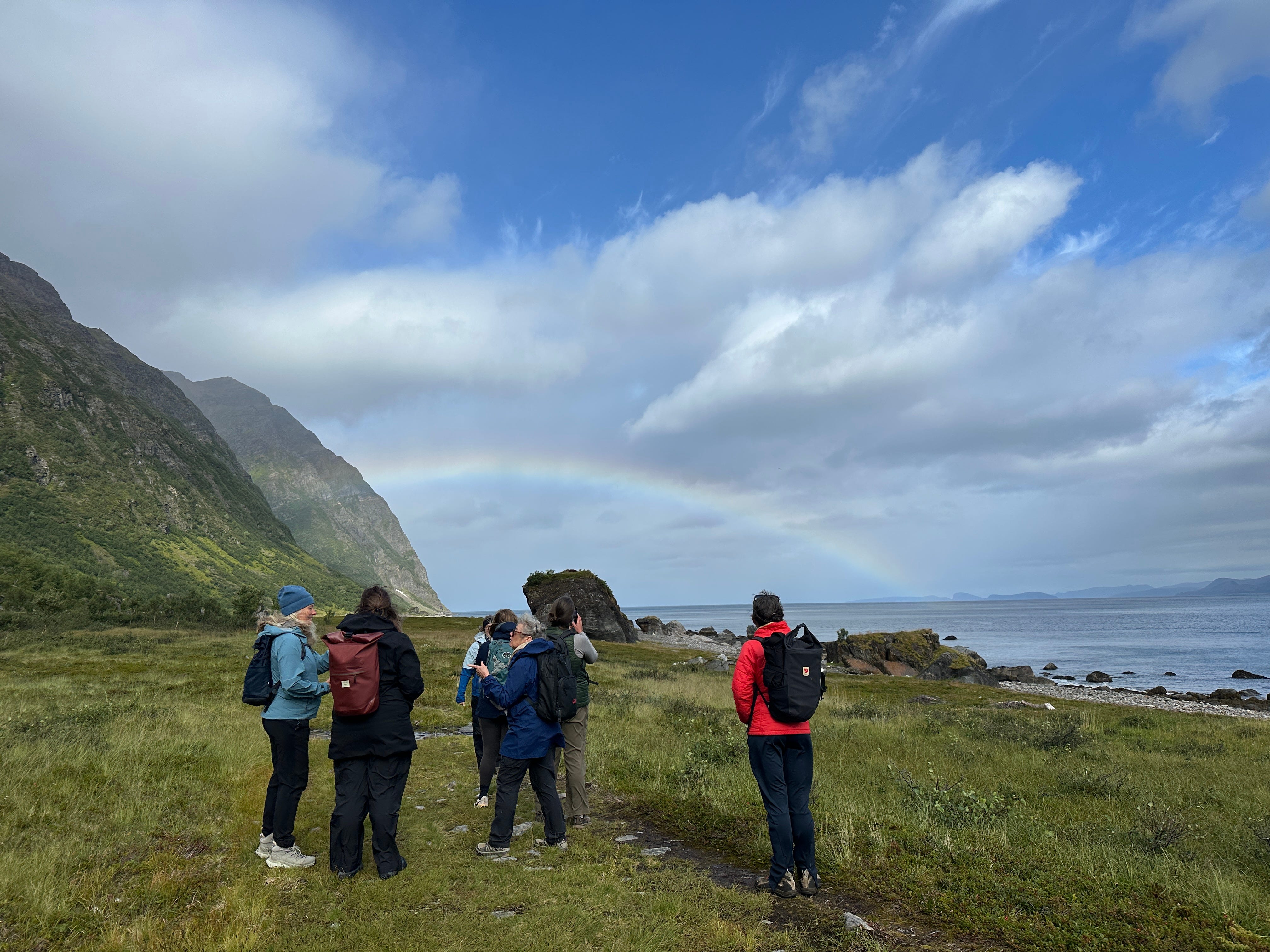
Want to take time to slow down, make art, connect with fellow creatives, take beach walk, breathe in salty air, forage for berries, and soak in the beauty that is Northern Norway? Then come join Hannah Viano and me for the the fourth edition of our popular Singla Creative Retreat next year, August 21-27, 2027.

Creative Seasons: Substack Live with Rosie Spinks
I have been very hesitant to do a Substack Live, but Rosie Spinks convinced me. We’re going to be in conversation on November 6 at 11:30am PT/2:30pm ET/7:30pm GMT to talk about we can harness the dark half of the year to fuel our creativity. If you want to join, put the date on your calendar and you’ll get an email when we kick things off.
Writing in the Deep: Inviting Your Grief to the Page
The world feels heavy right now—and let’s be honest, so do many of our hearts. Grief is a universal truth, something almost entirely inescapable in this life; it’s also a powerful thread of connection and a portal to our most potent and true stories. This winter, join beloved DIVE facilitator Kerri Anne for a timely and emotionally resonant workshop designed to hold space for any deep water you’re ready to explore.
Meets: November 17, November 24, and December 1. More info + tickets.
What We Bring to the Table: A Writing Workshop About Food, Memory, and Meaning
In times of grief, growth, and especially transition, food often becomes the anchor: the way we remember, the way we connect, the way we process what lives beyond our own language. It’s how we pass down stories without words—through spice jars, seed packets, heirloom tomatoes, and the fragrant rituals that fill a dining room. Food connects generations, connects us to the land around us, preserves traditions. Food helps us celebrate and honor the people, places, and flavor profiles that shape our individual and familial stories. Join Kerri Anne for a one-time (for now) notebook-nourishing food-writing workshop designed to help you reflect on the year that’s been—and everything it’s stirred up or shaken loose.
Meets December 8, 15, and 22. More tickets + info.

Do you like reading Creative Fuel? The best way to support it is to get a paid subscription.
This is independently produced art and writing and your support helps to keep the coffee flowing and the art supplies well stocked.
You can also share this newsletter with a friend!

Thank you for this story about young Mr. Hudson. I look forward to the workshop this week!
I have the solution for DST time change, but we have to get the whole world to agree. Just spilt the difference by 30 min. Set it, forget it, and never touch it again.