

Being Creatively Proactive
Personal creative manifestos and inspiration from Bertolt Brecht and Tove Jansson.
Hello friends,
I spent last weekend with two good friends and on Saturday afternoon we went to the Portland Art Museum. This was on the heels of a heavy morning, reading about the death of Alex Pretti. I was happy to be with friends in that particular moment, to get to talk through our emotions, hold it all together instead of alone.
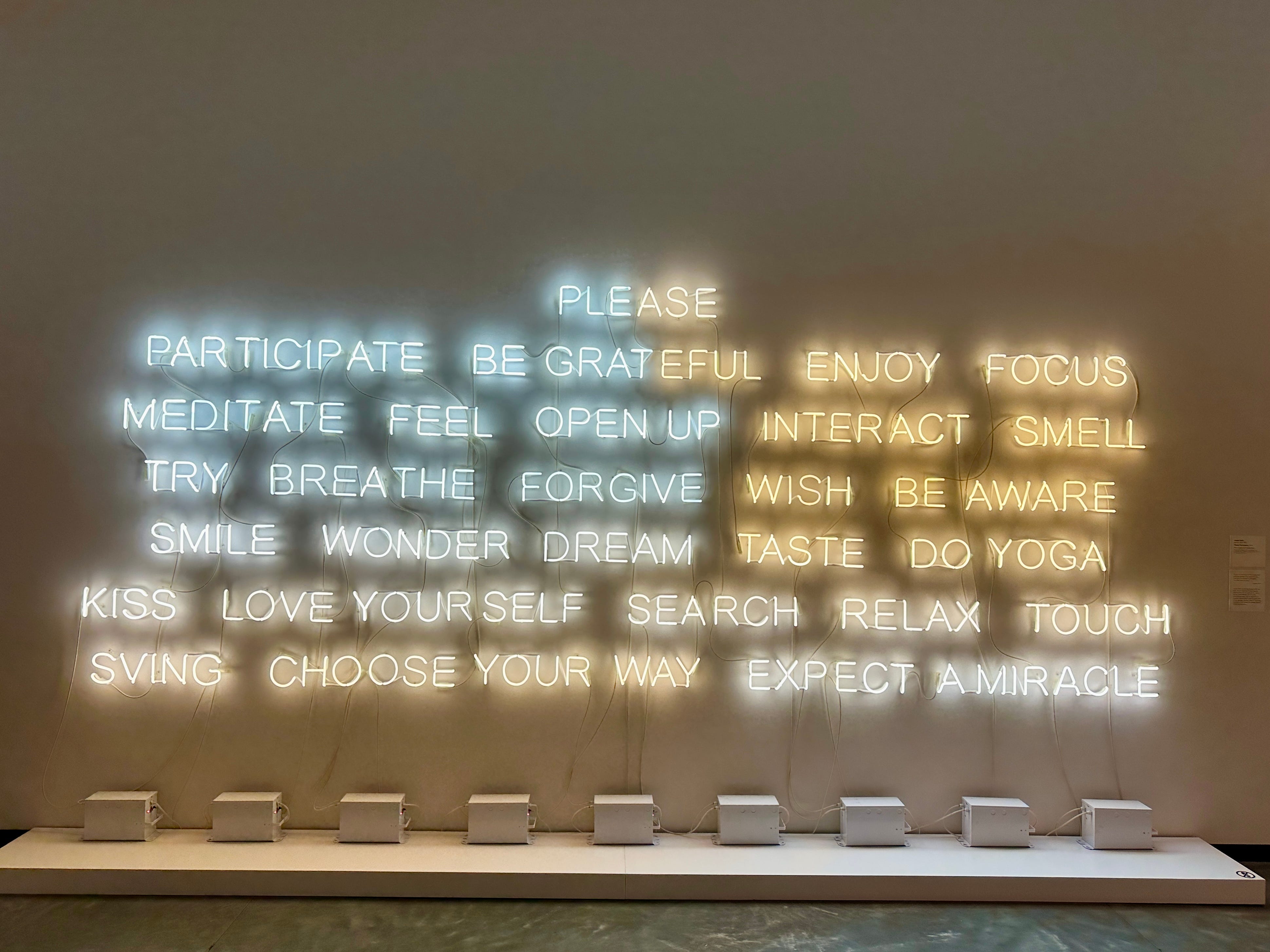
Our planned outing to the Portland Art Museum also felt like a balm. Last fall, the art museum opened after an extensive expansion and renovation, adding 100,000 square feet of new or upgraded public and gallery space. The museum was packed with people--all ages, all backgrounds.
I was struck by how energizing it was to be in a space that was dedicated to creation instead of destruction. Every single piece in that museum—just like in other museums, galleries, and even the art on the walls in our homes—represents a person making a choice to bring something into this world as opposed to destroying something.
Destruction is also part of the creative process. But even then, it is in the name of rebuilding. Artists destroy and dismantle in order to build something new, sift through the ashes and figure out what is salvageable, bring the broken, fractured pieces back to life in a new way.

The easiest creative actions during moments like the one we’re currently in are ones that take a stand. Protest posters come to mind, and also poetry that manages to find the words for the moment, like this one by Hannah Levy. There is so much good stuff being made right now, visual proof of how rage can be turned into creative inspiration.
I think of all of this as reactive art. We are responding to a situation. For many of us, words and visuals are how we process what’s happening around us. How we seek to understand, make sense of a situation.
But we can’t reside solely in response. We also have to build. This is art as preventative care. Looking into the future and identifying what kind of a world and systems we want to construct. Investing the creative energy now in the name of the ripple effects it has in the future.
A friend brought this over the other night for a collage project:
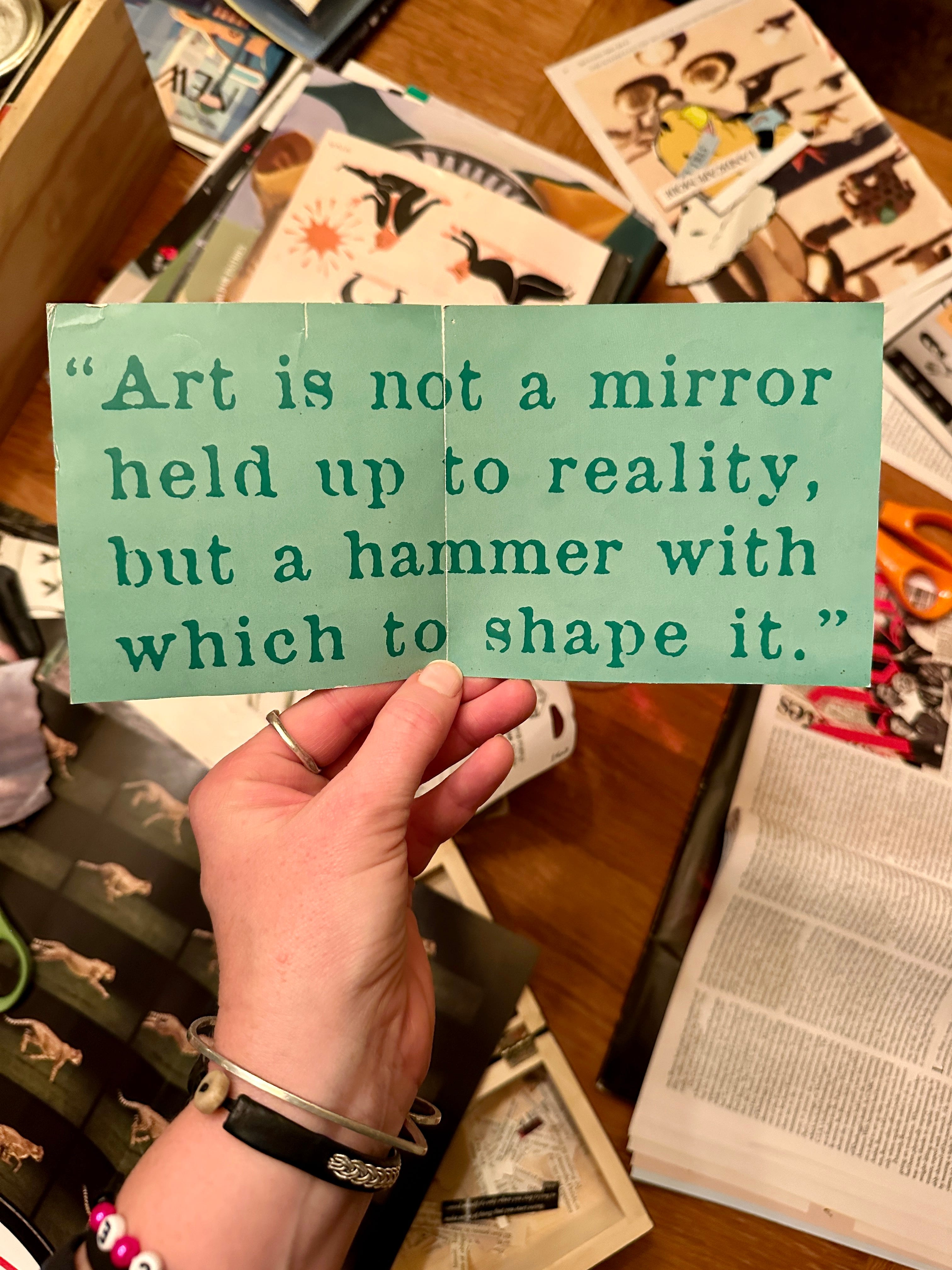
“Art is not a mirror held up to reality
but a hammer with which to shape it.”
- Bertolt Brecht
The quote is from German playwright and poet Bertolt Brecht. He served as a medical orderly in World War I, and appalled by the effects of the war, he abandoned his medical studies and turned to writing and theater instead. He developed his theory of “epic theatre,” an attempt to “shock audiences out of complacency.”
Brecht’s plays ended up being banned in Nazi Germany, and Brecht fled the country, first to Denmark, then Finland. Like many German artists and intellectuals, he eventually ended up in the United States. There, his work drew the attention of the House Un-American Activities Committee, where he was accused of “a number of very revolutionary poems, plays, and other writings.” After the hearings, he fled yet again, this time to Switzerland. Eventually in 1949, he ended up in East Berlin, where he ran the Berliner Ensemble theater company.
Depending on your intention, a hammer can be used to both destroy and build, which gives it particular power here as a symbol. There is an undeniable physicality to a hammer—you can feel the effort required to nail a wooden structure together. A reminder that building something takes time, work, commitment.
This isn’t an AI formula, it requires the physical investment of the artist. We can dream and imagine, but we also have to partake in the physical process of moving ourselves forward.
I was reading a piece by Pranay Somayajula in The Drift yesterday, documenting what on the ground resistance looks like in Minneapolis. Instead of asking “what radicalized you?” Somayajula suggests asking, “what protagonized you?”
These last few weeks (months? years?), so many days have gone to thinking about what we’re against. Fascism. State violence. Removal of people. Trampling of first amendment rights. We work at opposing those forces, particularly in crisis moments. We need that resistance work, but it’s equally important to build and invest in the systems we are for.
If there was a theme to the weekly newsletter this month, then it was certainly creativity and action. In pressing moments, art offers an outlet. Both in what we make and what we take in. Art becomes an act of resistance. Even our fallow activities are a form of action, allowing space for thinking, learning, growing—the quiet space where we can cut the noise instead of consuming mindlessly.
I wanted to end this month in that spirit, with creative action that’s not just reactive, but also proactive. The act of preventative creative care. A push for all of us to be creatively proactive.
What are your values? What do you stand for? How do you commit to weaving them into your creative work?
I know, big questions! They are questions I often come back to. These questions help establish the ethos that underpins your creative work, the moral and ethical scaffolding that holds up the rest, no matter the medium or the outlet. The values show up, whether you’re making the most beautiful illustration you can, throwing paint at a canvas in rage, researching and fact checking to make sure you tell a story correctly, or dreaming up an imaginary world that’s created solely to offer someone a place to land for a bit and breathe.
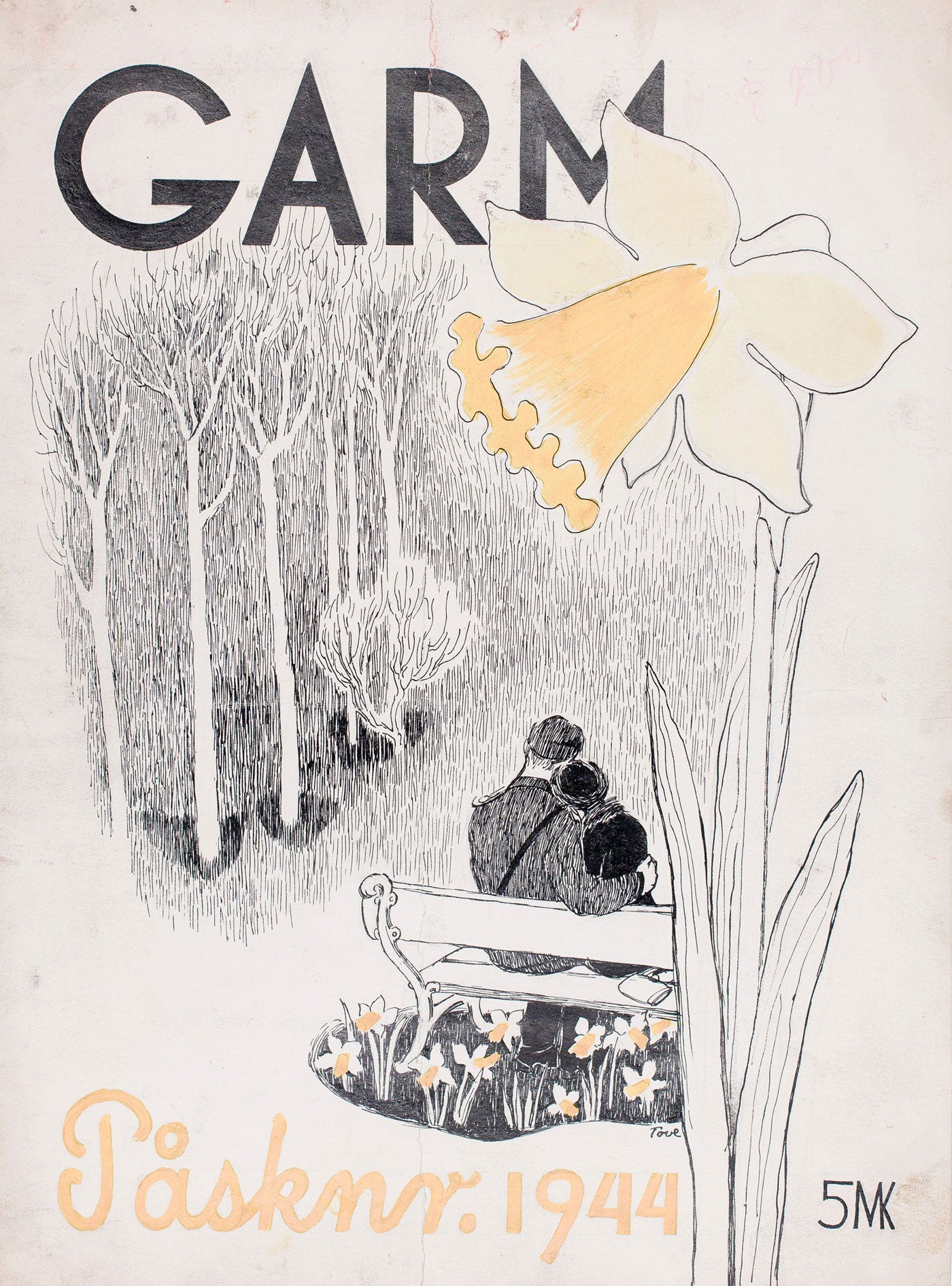
I often return to Tove Jansson’s letters for creative inspiration and grounding. She writes a lot about how her art and creative spirit suffered during World War II, and in many ways, her words often feel like they were specifically written for us to read in this moment.
In a letter to Eva Konikoff in October 1944, Jansson writes:
“Before [the war], all that mattered was for my pictures to live on when I was gone. That’s important now too. But more powerful than the longing to be “great,” to be famous, is the longing for joy, for happiness. For a whole year, Eva, I haven’t been able to paint. The war nearly did for my desire to, in the end. It took me time to understand that it has to be a road, not a destination. What I want now is for my paintings to be something that springs naturally from myself, preferably from my joy. And I want to be, I will be, happy.”
The Moomin series was born out of a similar spirit—the desire for a world that stemmed not from what was broken, but what was possible. Describing the beginnings of Moomin to Konikoff, Jansson writes that she began crafting Moomin:
“…when I was feeling depressed and scared of the bombing and wanted to get away from my gloomy thoughts to something else entirely. (A sort of escapism, to the time when Ham [Jansson’s mother] used to tell me stories.) I crept into an unbelievable world where everything was natural and benign--and possible. Then I went on writing whenever I felt like it, for my own fun…”
What did Jansson stand for? Certainly joy and love. You don’t have to look far to see what kind of impact that has had on a global scale. She may have tossed aside the longing to be great and famous, but in honing in on her most human emotions, she did just that.
That’s good inspiration for us to do the same.
-Anna
ANALOG INSPIRATION: CREATIVE MANIFESTOS
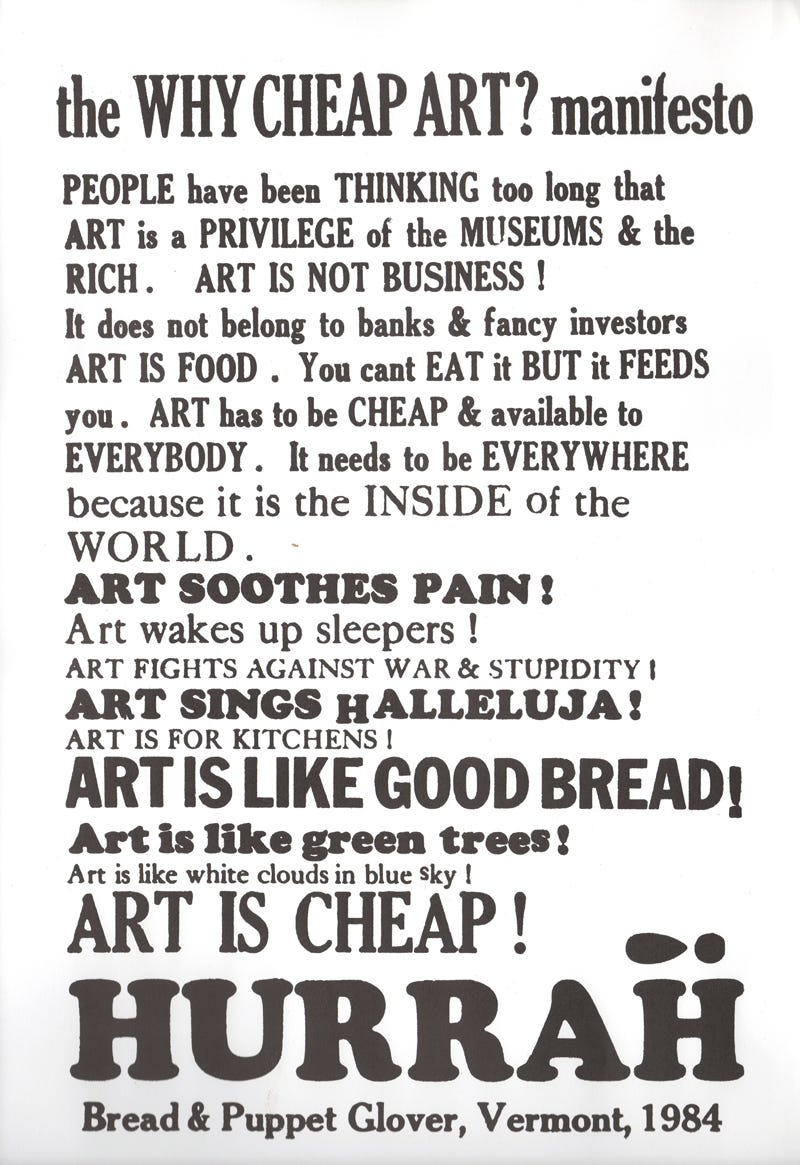
We’ve covered creative manifestos in this newsletter before, but I like to think of manifestos as living, breathing documents. Which means that even if you’ve made one in the past, it’s worth coming back to and revising. Manifestos offer the chance for clarity in your own creative values. Certainly needed in this moment!
For making your own manifesto: this is the how and why of what you create. What are you for? What do you want to build? What drives you?
I love the Cheap Art manifesto by Bread and Puppet, because it represents much more than just cheap art. It’s an entire ethos that can be applied to any project. Another favorite are the “Ten Rules” from Corita Kent and the Immaculate Heart College Art Department.
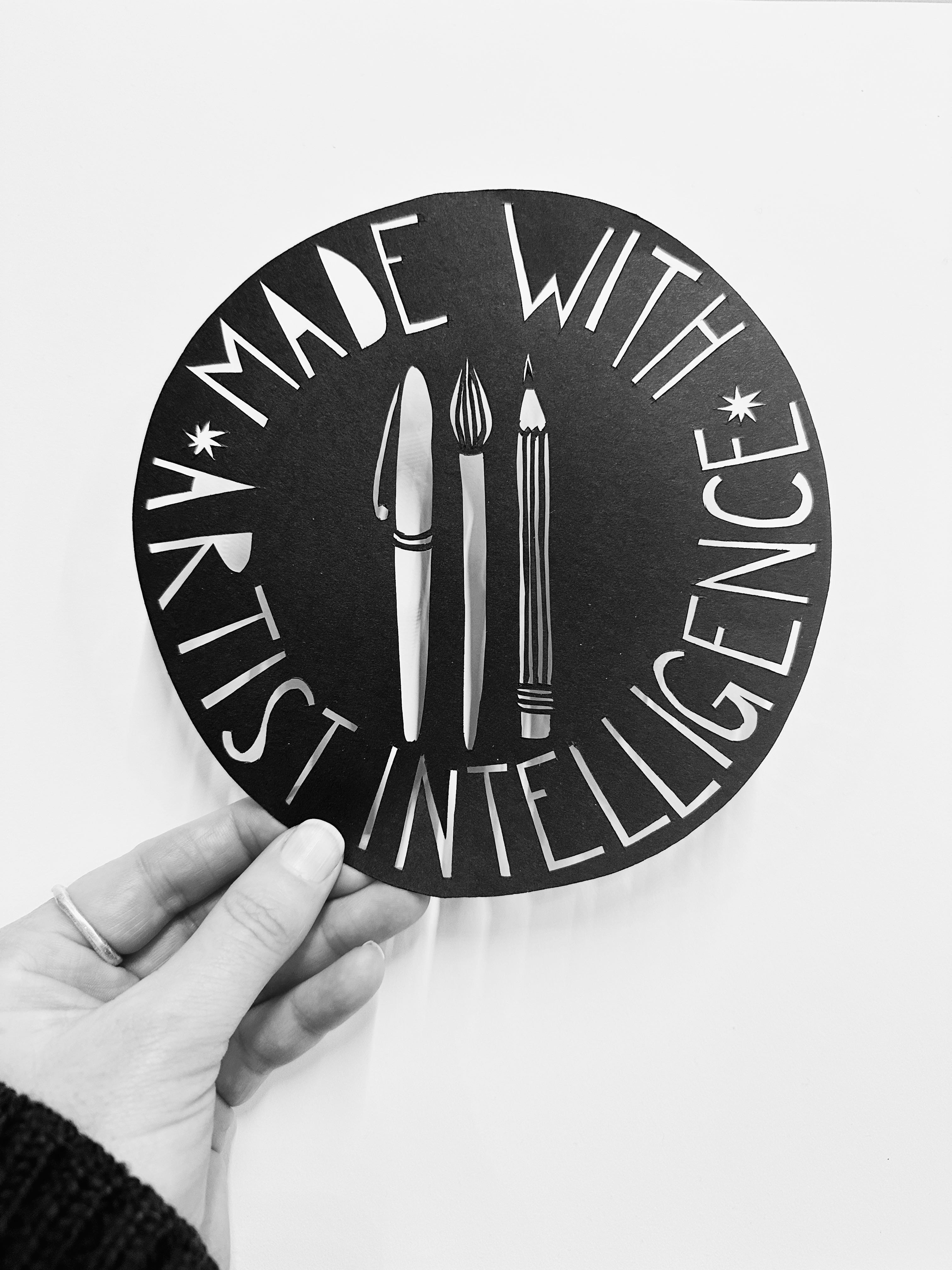
I haven’t a personal creative manifesto in a while, so I am excited to dig down into this as well. In the meantime, here’s a manifesto adjacent thing I did make this week., As always: handcut paper!

“Artistic ego is the best chance we have of battling against the rise of AI in creative spaces.” via
Chris La Tray is helping to organize the Indigipalooza festival in Missoula. To raise funds they’re also offering an online workshop series called Native American Resistance for Everyone Class. There are lots of amazing people on the list of guest speakers.
We Have All the Tools We Need flyer download from Christine Tyler Hill.
A pep talk from Maggie Smith
“The first rupture of democracy isn’t really between people and power. It’s between language and what words are willing to acknowledge or betray.”An excellent piece from Ava DuVernay

Not to add to your list, but the Made with Artist Intelligence paper cut would be an amazing sticker. Just saying!
I definitely needed the Bread and Puppet piece today. Making manifestos is a perfect idea!